
Search is evolving rapidly. Users are no longer relying only on traditional search engines to find information; they are increasingly using AI-powered platforms like ChatGPT, Google AI Overviews, Gemini, and Perplexity to ask questions, compare options, and make decisions.
This shift is changing how businesses need to approach SEO. Ranking on Google is still important, but modern SEO now requires businesses to optimize their content, website structure, and brand presence for AI-driven search experiences.
AI SEO (Artificial Intelligence Search Engine Optimization) is the process of optimizing your online presence so AI systems can better understand, trust, and recommend your business in generated answers and search responses.
Unlike traditional SEO, which primarily focuses on keywords and rankings, AI SEO focuses on deeper signals such as:
- Content quality and completeness
- User intent and conversational queries
- Brand authority and online mentions
- Entity recognition
- Expert-driven information
- Technical accessibility
Businesses that adapt to AI SEO can improve their chances of being discovered when potential customers ask AI platforms for recommendations, solutions, and industry insights.
In this guide, we will explore how AI SEO works, why it matters in 2026, and the strategies businesses can use to improve visibility in the next generation of search.
What Is AI SEO?
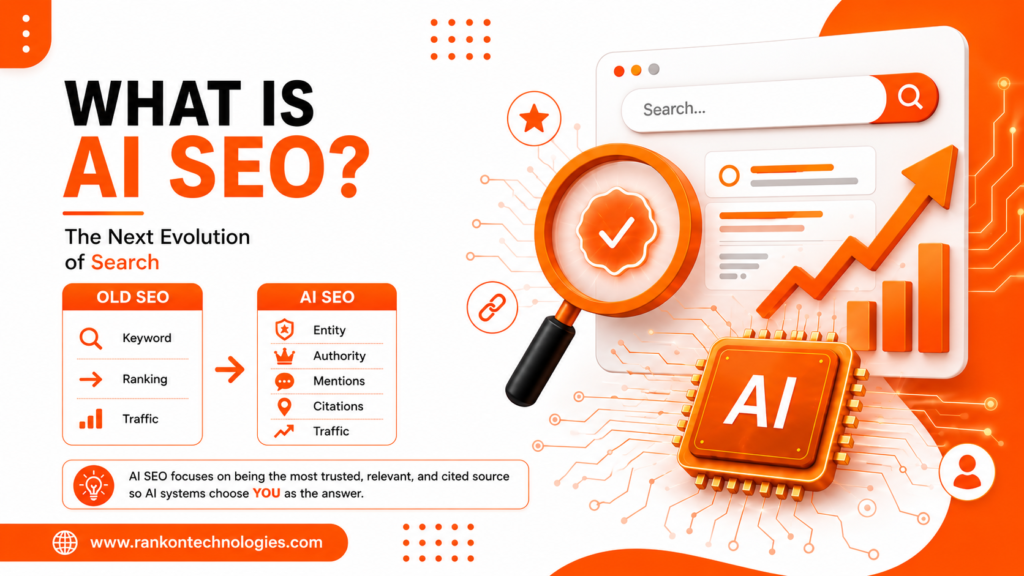
AI SEO is the process of optimizing your website and content so that both traditional search engines (Google, Bing) and AI-powered search platforms (ChatGPT, Gemini, Perplexity, and Google AI Overviews) can easily understand, trust, and recommend your business.
Unlike traditional SEO, which focuses mainly on ranking web pages, AI SEO aims to improve your visibility across search engines and AI-generated answers.
Why Traditional Search Is Changing
Search has changed significantly over the last few years. People no longer rely solely on typing a few keywords into Google and clicking through multiple websites to find answers. With the rise of AI-powered search engines and assistants, users expect faster, more personalized, and conversational responses.
Instead of simply ranking webpages, modern search platforms aim to understand user intent and provide direct answers. This shift is changing how businesses need to approach SEO.
The Growth of AI-Powered Search
Artificial intelligence is now deeply integrated into how people discover information online. Platforms like Google AI Overviews, ChatGPT, Microsoft Copilot, Perplexity AI, and Gemini can generate answers by analyzing information from multiple trusted sources.
Rather than displaying a list of ten blue links, these platforms often summarize the information and cite websites they consider authoritative. As a result, brands that create trustworthy, well-structured, and helpful content have a greater opportunity to be featured in AI-generated responses.
Search Has Become More Conversational
Users are interacting with search engines more like they would with a person. Instead of searching for:
- best CRM software
They now ask:
- What is the best CRM software for a small business with fewer than 20 employees?
- Which CRM offers the best value for startups?
- Can you compare HubSpot and Zoho CRM for a growing business?
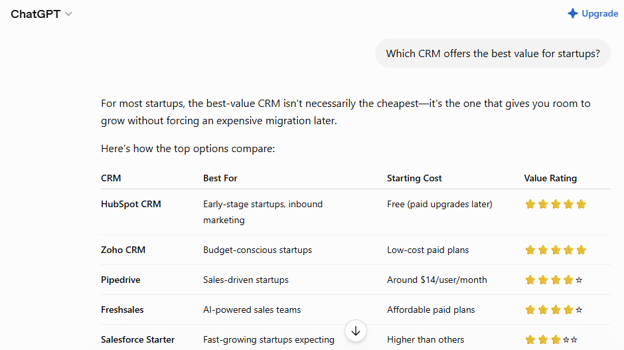
These natural-language queries require search engines to understand context, intent, and meaning—not just keywords. This is why modern SEO focuses on creating comprehensive content that answers real user questions rather than targeting individual keywords alone.
Fewer Clicks, More Instant Answers
AI-powered search experiences increasingly provide answers directly on the search results page. Users can often get the information they need without visiting multiple websites.
This doesn’t mean SEO is becoming less important. Instead, the goal is evolving. Businesses should optimize their content so it becomes one of the trusted sources AI systems reference when generating answers. Being cited by AI can improve brand visibility, build trust, and still drive qualified traffic from users who want more detailed information.
AI Recommendations Influence Buying Decisions
Consumers are beginning to rely on AI assistants for product recommendations, service comparisons, travel planning, software selection, and purchasing decisions.
For example, someone may ask:
“Recommend the best SEO agency for healthcare businesses.”
Instead of showing only a list of websites, AI may compare several agencies, highlight their strengths, and recommend those with strong authority, positive reputation, relevant expertise, and high-quality content.
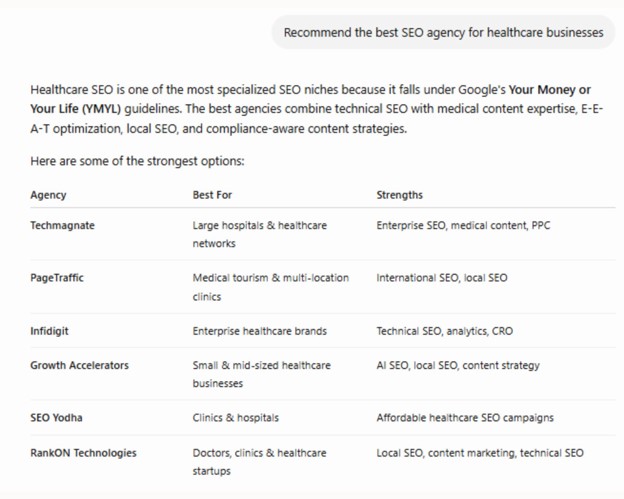
This means businesses must go beyond ranking for keywords. Building topical authority, demonstrating expertise, earning quality backlinks, maintaining accurate business information, and publishing valuable content all contribute to becoming a trusted recommendation.
People Search Across Multiple AI Platforms
Google is no longer the only place where people search for information. Many users now split their searches across multiple AI-powered platforms depending on their needs.
For example:
- Google AI Overviews for quick answers and web searches.
- ChatGPT for research, brainstorming, and detailed explanations.
- Perplexity AI for answers backed by cited sources.
- Microsoft Copilot for productivity and web-assisted searches.
- Gemini for Google-integrated AI assistance.
Each platform may evaluate and present information differently, but they all prioritize content that is accurate, well-organized, trustworthy, and demonstrates real expertise.
What This Means for Businesses
Traditional SEO remains the foundation of online visibility, but it’s no longer enough to focus only on rankings and keywords. Businesses that want to stay competitive should also optimize for how AI systems discover, understand, evaluate, and reference content.
This shift has given rise to AI SEO—an approach that combines proven SEO best practices with strategies designed to improve visibility across AI-powered search experiences. In the next section, we’ll explore exactly what AI SEO is and how it differs from traditional SEO.
AI SEO vs Traditional SEO
Although AI SEO builds upon traditional SEO principles, its primary goal is different. Traditional SEO focuses on improving rankings in search engine results pages (SERPs), while AI SEO aims to increase your brand’s visibility within AI-generated answers and recommendations.
| Traditional SEO | AI SEO |
| Focuses on ranking web pages | Focuses on getting cited in AI-generated responses |
| Optimizes for search engine algorithms | Optimizes for AI language models and search assistants |
| Keyword-focused optimization | Topic and entity-focused optimization |
| Success measured by rankings and organic traffic | Success measured by AI mentions, citations, visibility, and qualified traffic |
| Optimized mainly for Google Search | Optimized for Google AI Overviews, ChatGPT, Perplexity, Gemini, Copilot, and other AI platforms |
| Competes for clicks | Competes for trust, authority, and recommendations |
The good news is that you don’t need two separate SEO strategies. Strong technical SEO, high-quality content, topical authority, and trusted backlinks remain essential. AI SEO simply extends these best practices to help AI systems understand, trust, and recommend your content.
How to Measure AI SEO Success
Unlike traditional SEO, AI SEO isn’t measured solely by keyword rankings. Since AI platforms generate answers differently, businesses should monitor multiple performance indicators.
Some of the most valuable AI SEO metrics include:
AI Citations
Check whether your website is being referenced in Google AI Overviews, Perplexity AI, ChatGPT, Gemini, and other AI-powered search experiences.
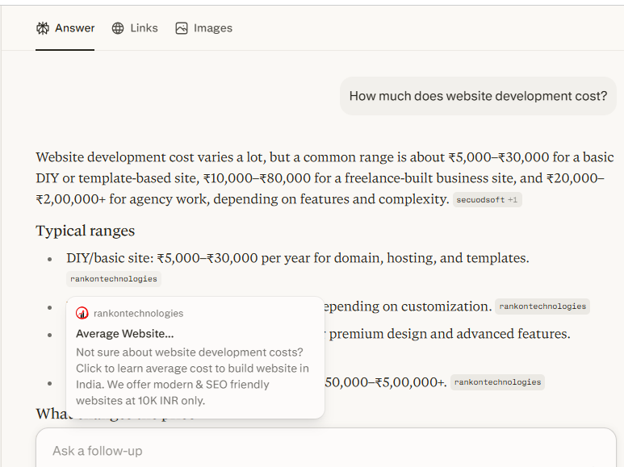
Brand Mentions
Even when users don’t click your website, being mentioned by AI platforms increases brand awareness and builds credibility.
Organic Traffic Quality
Instead of focusing only on traffic volume, analyze whether AI-generated visitors spend more time on your website, view additional pages, or convert into leads and customers.
Search Visibility
Track how often your content appears in AI-generated summaries alongside traditional search results.
Topical Authority
Monitor whether your website consistently appears across multiple related topics instead of ranking for isolated keywords.
Business Results
Ultimately, AI SEO should contribute to business growth. Measure improvements in qualified leads, enquiries, demo requests, bookings, or revenue—not just visibility.
Common AI SEO Myths
As AI search evolves, many misconceptions have emerged. Let’s separate fact from fiction.
Myth 1: Traditional SEO Is Dead
Reality: Traditional SEO remains the foundation of AI SEO. Technical optimization, quality content, internal linking, backlinks, and user experience continue to influence AI visibility.
Myth 2: AI Content Automatically Ranks Better
Reality: Search engines prioritize helpful, accurate, and original content—not whether it was written by AI or humans. AI can assist content creation, but human expertise, editing, and real-world experience remain essential.
Myth 3: More Keywords Mean Better AI Visibility
Reality: Modern AI understands context and intent. Comprehensive topic coverage and clear answers are far more valuable than excessive keyword repetition.
Myth 4: AI SEO Is Only About ChatGPT
Reality: AI SEO covers multiple platforms including Google AI Overviews, Gemini, Microsoft Copilot, Perplexity AI, Claude, and future AI-powered search engines.
Myth 5: Schema Markup Alone Will Get You Featured
Reality: Structured data helps search engines understand your content, but it cannot replace quality information, topical authority, and website trust.
AI SEO Checklist
Before publishing content, use this checklist to improve its AI visibility.
✅ Answer real user questions clearly.
✅ Cover the topic comprehensively.
✅ Demonstrate first-hand expertise where possible.
✅ Use descriptive headings and logical structure.
✅ Add relevant schema markup.
✅ Build strong internal links.
✅ Reference trustworthy sources when appropriate.
✅ Keep content updated regularly.
✅ Optimize page speed and Core Web Vitals.
✅ Build authoritative backlinks.
✅ Strengthen your brand’s online reputation.
✅ Ensure business information is accurate across the web.
AI SEO Workflow
AI SEO works best when approached as an ongoing process rather than a one-time optimization.
Keyword & Topic Research
↓
Understand Search Intent
↓
Create Helpful, Comprehensive Content
↓
Optimize Technical SEO & Schema
↓
Strengthen Internal Linking
↓
Build Authority Through Quality Backlinks
↓
Improve Brand Signals & Online Reputation
↓
Monitor AI Mentions & Performance
↓
Refresh & Expand Content Regularly
Each stage strengthens your website’s ability to be understood, trusted, and recommended by AI-powered search platforms.
30-Day AI SEO Action Plan
If you’re just getting started, here’s a practical AI SEO roadmap.
Week 1: Audit Your Website
- Review technical SEO.
- Fix crawl and indexing issues.
- Improve Core Web Vitals.
- Update schema markup.
Week 2: Improve Existing Content
- Expand thin pages.
- Add FAQs.
- Improve topical depth.
- Update outdated information.
Week 3: Build Authority
- Earn quality backlinks.
- Improve internal linking.
- Strengthen author profiles.
- Increase brand mentions.
Week 4: Measure and Improve
- Monitor AI citations.
- Review Search Console data.
- Analyze traffic quality.
- Refresh high-potential content.
Continue repeating this process each month to build long-term AI visibility.
AI SEO Challenges and Limitations
While AI SEO presents exciting opportunities, it’s important to understand its limitations.
AI Search Is Constantly Changing
AI platforms evolve rapidly. Optimization strategies that work today may need adjustment as new models and features are released.
Limited Performance Data
Unlike traditional SEO tools, there is currently limited visibility into how often AI platforms reference specific websites.
Different AI Platforms Behave Differently
Google AI Overviews, ChatGPT, Gemini, Perplexity AI, and Copilot use different technologies and may cite different sources for the same question.
AI Can Make Mistakes
AI-generated responses may occasionally contain outdated information or inaccuracies. Maintaining accurate, up-to-date content improves your chances of being referenced correctly.
No Guaranteed AI Citations
Even high-quality websites cannot guarantee inclusion in AI-generated answers. The goal is to consistently build trust, authority, and relevance over time.
The Future of AI Search
AI search will continue evolving beyond simple question-and-answer experiences. Businesses that adapt early will be better positioned to maintain visibility as search technology advances.
Some trends likely to shape the future include:
- More personalized search experiences based on user preferences and context.
- Greater use of multimodal search combining text, images, videos, and voice.
- AI agents capable of researching, comparing, and completing tasks on behalf of users.
- Increased importance of brand authority and real-world expertise.
- More emphasis on fresh, trustworthy, and experience-driven content.
Rather than replacing SEO, AI is expanding it. Businesses that invest in high-quality content, technical excellence, and strong online authority today will be better prepared for the next generation of search.
AI SEO Examples: How AI Search Mentions Websites
The easiest way to understand AI SEO is to see how AI-powered search engines present information.
For example, a user might ask:
“What are the best project management tools for remote teams?”
Instead of displaying only a list of webpages, an AI-powered search engine may generate a summary comparing several tools such as Asana, Trello, Monday.com, and ClickUp. It may also explain the strengths of each option and provide links to trusted sources for further reading.
Similarly, someone searching:
“How can I improve my website’s AI search visibility?”
may receive an AI-generated answer that summarizes best practices from multiple authoritative websites instead of directing them to a single page.
These examples highlight an important shift: success is no longer measured only by ranking #1 in traditional search results. Increasingly, businesses benefit from becoming one of the trusted sources that AI systems reference when generating answers.
Why Does AI SEO Matter in 2026?
In 2026, AI SEO matters because the way people search for information has changed dramatically. Traditional search engines are no longer the only source users rely on.
AI-powered platforms and search experiences now provide direct answers, personalized recommendations, and conversational results, making it essential for businesses to optimize not just for rankings, but for visibility across AI-driven ecosystems.
Here are the key reasons why AI SEO is more important than ever:
1. Search Has Become AI-Driven
Search engines increasingly use artificial intelligence to understand user intent rather than simply matching keywords. AI-powered search experiences summarize information, answer questions directly, and recommend trusted sources.
Businesses that optimize for AI-generated results have a greater chance of being discovered by potential customers.
2. Users Expect Instant Answers
People now ask complex, conversational questions instead of typing short keywords. AI SEO helps brands create content that addresses these natural-language queries, making it easier for AI search engines and assistants to surface relevant answers.
3. Visibility Goes Beyond Google Rankings
Success in 2026 isn’t measured solely by page-one rankings. Brands also need visibility in:
- AI search engines
- Generative search experiences
- Voice assistants
- Chatbots and virtual agents
- Featured snippets and answer boxes
AI SEO ensures your content can be understood and referenced across multiple channels.
4. Better Understanding of Search Intent
Modern AI systems analyze context, user behavior, and semantic relationships. Businesses that focus on topical authority and user intent rather than keyword stuffing are rewarded with stronger visibility and higher-quality traffic.
5. Faster Content Production and Optimization
AI tools streamline many SEO tasks, including:
- Keyword and topic research
- Content briefs
- Technical SEO audits
- Internal linking recommendations
- Competitor analysis
- Content optimization
This allows teams to scale content creation while maintaining quality and reducing operational costs.
6. E-E-A-T Has Become More Important
Experience, Expertise, Authoritativeness, and Trustworthiness (E-E-A-T) remain essential signals in 2026. AI search systems prioritize content that demonstrates:
- First-hand experience
- Expert insights
- Reliable sources
- Accurate and updated information
- Strong brand authority
Businesses that consistently publish trustworthy content are more likely to be cited and recommended by AI-powered search experiences.
7. Competitive Advantage for Early Adopters
Companies investing in AI SEO today are building authority that competitors may struggle to catch up with later.
Brands that understand how AI systems retrieve, summarize, and recommend content can gain a significant advantage in organic visibility and customer acquisition.
8. SEO AI SEO Supports the Entire Customer Journey
AI SEO helps businesses attract users at every stage:
| Customer Stage | AI SEO Impact |
| Awareness | Builds brand visibility |
| Consideration | Answers questions and educates prospects |
| Decision | Demonstrates expertise and trust |
| Retention | Provides ongoing value through helpful content |
9. SEO Data-Driven Decision Making
AI-powered SEO platforms provide deeper insights into:
- Emerging search trends
- User behavior
- Competitor strategies
- Content gaps
- Predictive opportunities
This enables businesses to make smarter marketing decisions and adapt quickly to changing search patterns.
10. SEO Future-Proofing Organic Growth
Search will continue evolving, but one principle remains constant: users want accurate, relevant, and trustworthy answers. AI SEO helps businesses align with these expectations and remain visible as search technology advances
Understanding AIO, GEO, AEO, and SEO in the Age of AI
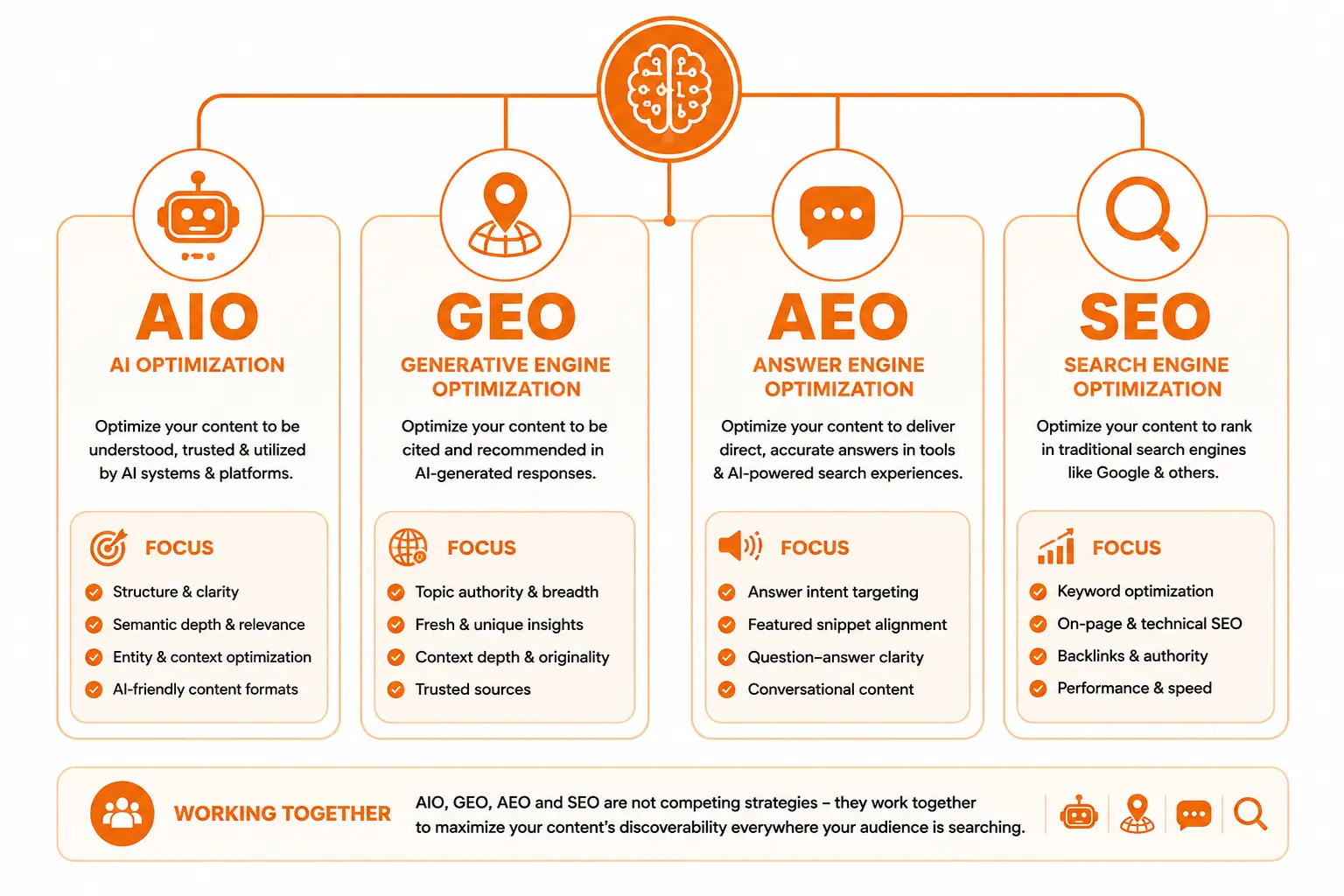
As search evolves, businesses are hearing new terms beyond traditional SEO. Here’s what they mean:
1. SEO (Search Engine Optimization)
SEO is the practice of improving a website’s visibility on search engines like Google. It involves keyword research, content creation, technical optimization, and link building to increase organic traffic and rankings.
2. AEO (Answer Engine Optimization)
AEO focuses on optimizing content to provide direct answers to users’ questions. It helps content appear in featured snippets, voice search results, and AI-powered answer boxes.
3. GEO (Generative Engine Optimization)
GEO is the process of optimizing content for AI-driven search platforms and generative engines. The goal is to ensure that tools like AI chatbots and search assistants recognize, reference, and recommend your content.
4. AIO (AI Optimization)
AIO refers to using artificial intelligence to improve SEO efforts. AI tools can assist with keyword research, content optimization, competitor analysis, and performance tracking, helping marketers work more efficiently.
Here’s Why They Matter Together:
Modern digital marketing is no longer limited to traditional SEO. Businesses that combine SEO, AEO, GEO, and AIO are better positioned to increase visibility across search engines, AI assistants, and emerging search experiences.
By embracing these strategies, brands can stay competitive and reach audiences wherever they search for information.
How Do AI Search Engines Work?
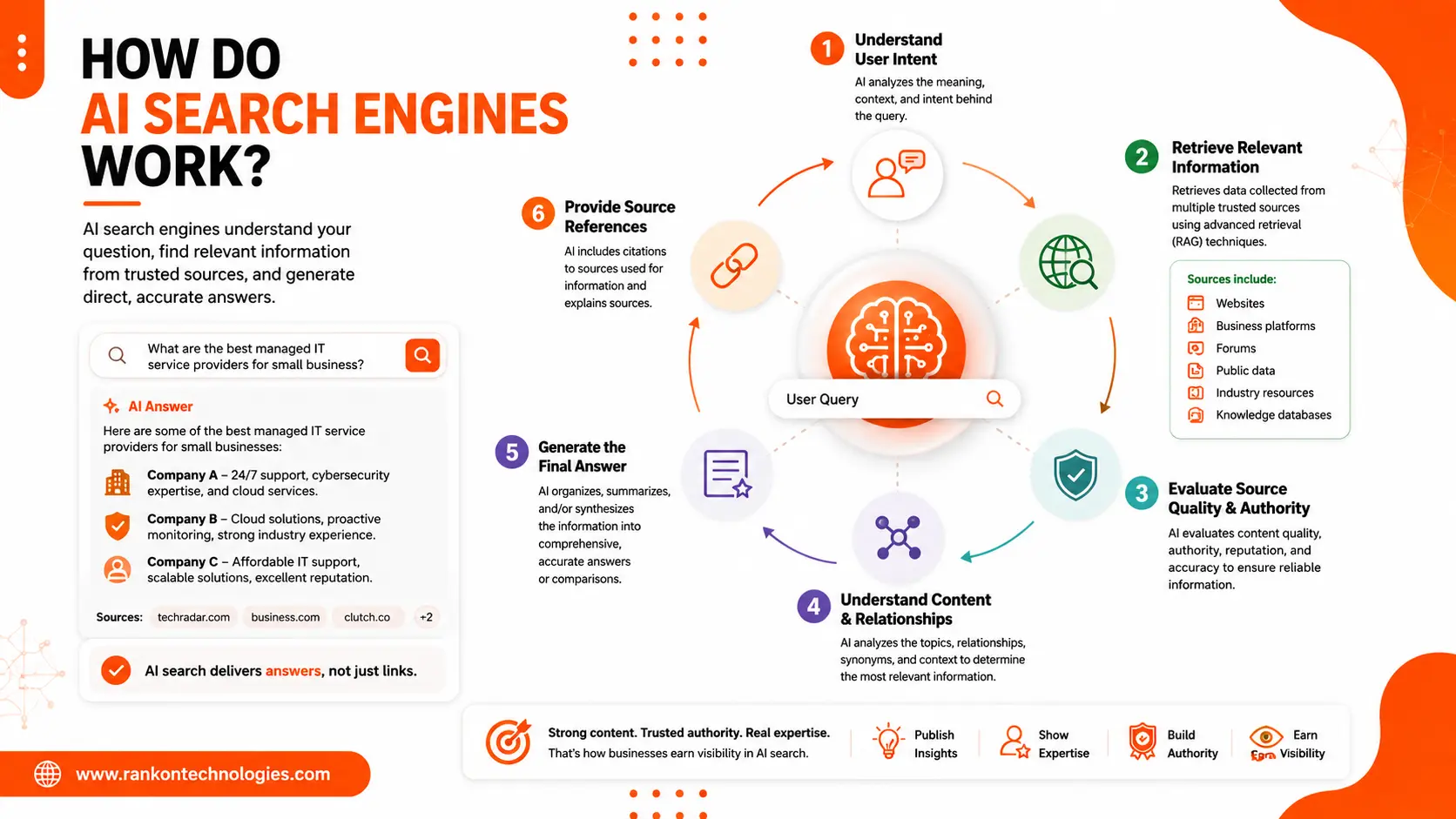
AI search engines use advanced artificial intelligence models, natural language processing (NLP), and machine learning technologies to understand user questions, find relevant information, and generate direct answers.
Unlike traditional search engines that primarily display a list of website links, AI search systems analyze information from multiple sources and create summarized responses based on their understanding of the query.
The process generally involves the following steps:
1. Understanding User Intent
The first step in AI search is understanding what the user is actually looking for.
Traditional search often focuses on matching keywords, while AI search attempts to understand:
- The meaning behind the query
- User intent
- Context of the question
- Specific requirements
- Previous interactions (where applicable)
For example, instead of only matching the keywords “best cybersecurity company”, an AI search engine may understand that the user wants recommendations based on factors such as:
- Company size
- Industry experience
- Security solutions offered
- Reviews and reputation
- Location
This allows AI systems to provide more personalized and relevant answers.
2. Retrieving Relevant Information
After understanding the query, AI search systems collect information from various sources to generate an answer.
These sources may include:
- Websites
- Business profiles
- Trusted publications
- Reviews
- Industry resources
- Structured data
- Knowledge databases
Many AI search systems use a process called Retrieval-Augmented Generation (RAG), where the AI model retrieves relevant information from external sources before generating a response.
This helps AI systems provide more accurate and up-to-date answers.
3. Evaluating Source Quality and Authority
AI search engines do not simply select information randomly. They evaluate sources based on different trust and relevance signals.
Important signals may include:
- Content quality
- Industry expertise
- Website authority
- Brand reputation
- Reviews and mentions
- Accuracy of information
- Consistency across online platforms
For businesses, this means that having strong digital authority becomes increasingly important for AI visibility.
4. Understanding Content and Relationships
AI systems analyze content beyond individual keywords. They try to understand:
- Topics covered
- Relationships between concepts
- Expertise demonstrated
- Questions answered
- Context and meaning
For example, an IT company that publishes detailed content about:
- Cloud migration
- Cybersecurity
- Managed IT services
- Industry-specific solutions
- Technology challenges
may be recognized as a more relevant source for related AI queries. This strategy will definitely boost AI SEO for IT companies.
This is why creating comprehensive, expertise-driven content is an important part of AI SEO.
5. Generating the Final Answer
After analyzing information, the AI system creates a response using natural language generation.
Instead of showing only rankings like traditional search results, AI search may provide:
- Direct answers
- Summaries
- Recommendations
- Comparisons
- Lists of businesses or solutions
- Follow-up suggestions
For example, a user searching: “What are the best managed IT service providers for small businesses?”
may receive an AI-generated list based on information gathered from multiple sources.
6. Providing Source References
Many AI search platforms now include citations or references to the websites used to generate answers.
These citations help users verify information and allow businesses to gain visibility when their content is selected as a trusted source.
To improve the chances of being cited, businesses should focus on:
- Publishing original insights
- Creating detailed educational content
- Demonstrating expertise
- Maintaining accurate business information
- Building authority through mentions and reviews
AI vs. Traditional Search Engines Working Process
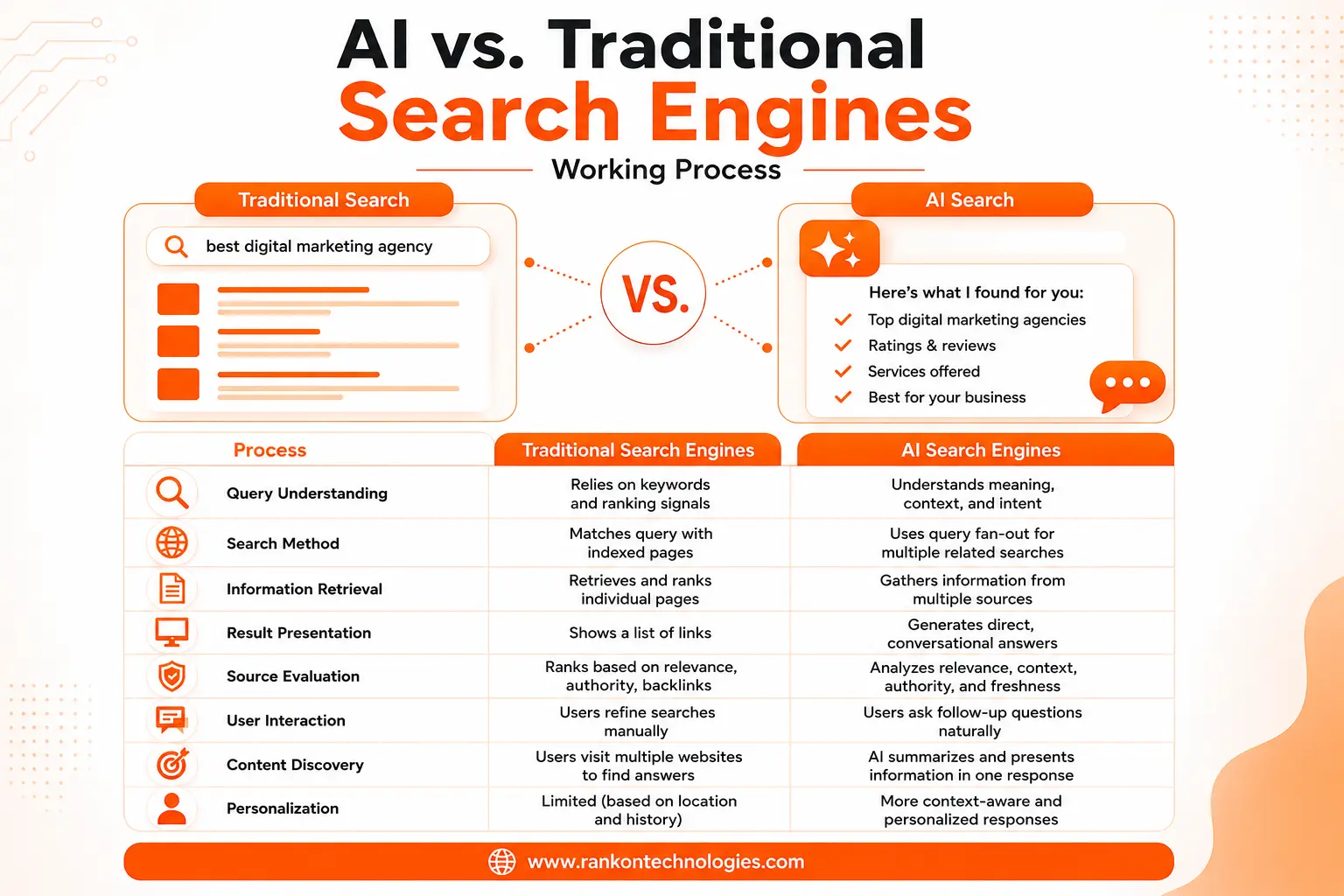
Although both AI search engines and traditional search engines help users find information, the ways they process queries and deliver results differ significantly.
| Process | Traditional Search Engines | AI Search Engines |
| Query Understanding | Primarily rely on keywords and ranking signals. | Focus on understanding the meaning and intent behind the query. |
| Search Method | Match the query with indexed web pages. | Use query fan-out to perform multiple related searches. |
| Information Retrieval | Retrieve and rank individual web pages. | Gather information from multiple sources simultaneously. |
| Result Presentation | Display a list of links for users to explore. | Generate direct, conversational answers. |
| Source Evaluation | Rank pages based on relevance, authority, backlinks, and technical factors. | Analyze relevance, context, authority, and freshness across various sources. |
| User Interaction | Users refine searches manually. | Users can ask follow-up questions in a conversational manner. |
| Content Discovery | Users visit several websites to find answers. | AI summarizes information and presents it in one response. |
| Personalization | Limited personalization based on location and history. | Delivers more context-aware and personalized responses. |
As AI-powered search continues to evolve, businesses should optimize content not only for search rankings but also for AI-driven experiences. Combining traditional SEO with Answer Engine Optimization (AEO) and Generative Engine Optimization (GEO) will be essential for maintaining visibility in the future of search.
What Are the Core Pillars of AI SEO?
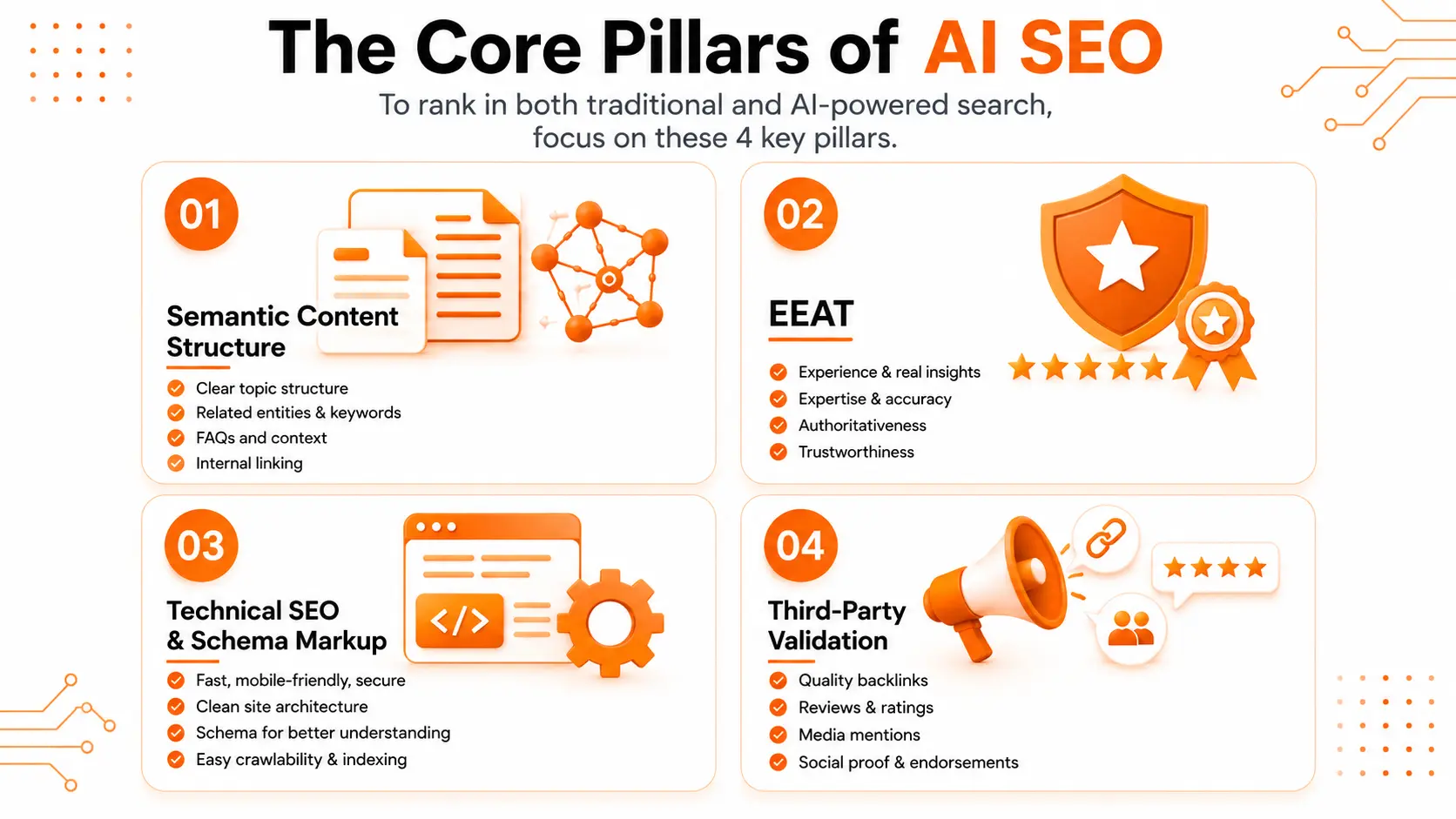
As search engines become increasingly intelligent, traditional keyword optimization alone is no longer enough. AI SEO is built on several interconnected pillars that help search engines understand not just what your content says, but also whether it deserves to be trusted and recommended.
Businesses that master these foundations are better positioned to rank in both traditional search results and AI-powered experiences.
Businesses succeeding with AI SEO usually focus on four key pillars.
1. Semantic Content Structure
Modern search engines no longer look at individual keywords in isolation. Instead, they analyze topics, relationships, and context.
Semantic content structure involves organizing information in a way that helps AI systems understand the meaning behind your content. Rather than creating isolated pages targeting single keywords, businesses should build comprehensive topic clusters and answer related questions naturally.
A strong semantic structure includes:
- Clear heading hierarchy (H1, H2, H3)
- Topic clusters and pillar pages
- Related keywords and entities
- FAQs and contextual information
- Internal linking between relevant pages
For example, an article about AI SEO should naturally discuss search intent, EEAT, schema markup, content optimization, and AI search engines instead of repeating the phrase “AI SEO” excessively.
2. EEAT (Experience, Expertise, Authoritativeness, and Trustworthiness)
Google increasingly prioritizes content created by people and brands that demonstrate genuine knowledge and credibility.
EEAT consists of:
- Experience
Content should reflect real-world insights and first-hand perspectives rather than generic information.
- Expertise
Authors should possess subject matter knowledge and provide accurate, valuable information.
- Authoritativeness
Brands and websites should establish themselves as recognized sources within their industry.
- Trustworthiness
Transparency, security, citations, reviews, and accurate information help build trust with both users and search engines.
In the age of AI-generated content, trust has become one of the most important ranking signals. Search engines want to reward businesses that provide authentic expertise and reliable information.
3. Technical SEO and Schema Markup
Even exceptional content requires a strong technical foundation. Technical SEO ensures that search engines can efficiently crawl, understand, and index your website. Key elements include:
- Fast page loading speeds
- Mobile-friendly design
- Secure HTTPS connections
- Optimized site architecture
- Proper internal linking
- XML sitemaps and crawlability
Schema markup adds another layer of understanding by providing structured data that helps search engines interpret content more accurately.
Common types of schema include:
- Article schema
- FAQ schema
- Product schema
- Local Business schema
- Organization schema
- Review schema
Structured data improves visibility, enhances rich search results, and increases the likelihood of being referenced in AI-generated answers.
4. Third-Party Validation
Search engines and AI systems increasingly rely on external signals to evaluate credibility. In other words, what others say about your brand matters almost as much as what you say about yourself.
Third-party validation includes:
- High-quality backlinks from authoritative websites
- Customer reviews and ratings
- Media mentions and press coverage
- Industry awards and certifications
- Citations across trusted directories
- Social proof and expert endorsements
For example, if respected publications, customers, and industry leaders consistently reference your business, AI systems interpret those signals as evidence of authority and trust.
Why These Pillars Matter
Think of AI SEO as a four-legged table. Semantic content structure provides context, EEAT builds trust, technical SEO and schema markup create accessibility, and third-party validation establishes authority. Remove one pillar, and the entire strategy becomes unstable.
Businesses that invest in these core pillars aren’t just optimizing for today’s search engines. They’re building digital assets that will remain valuable as AI-powered search continues to evolve.
AI SEO Guide: How to Optimize And Rank Your Website in AI Results?
Step 1: Perform AI SEO Keyword Research
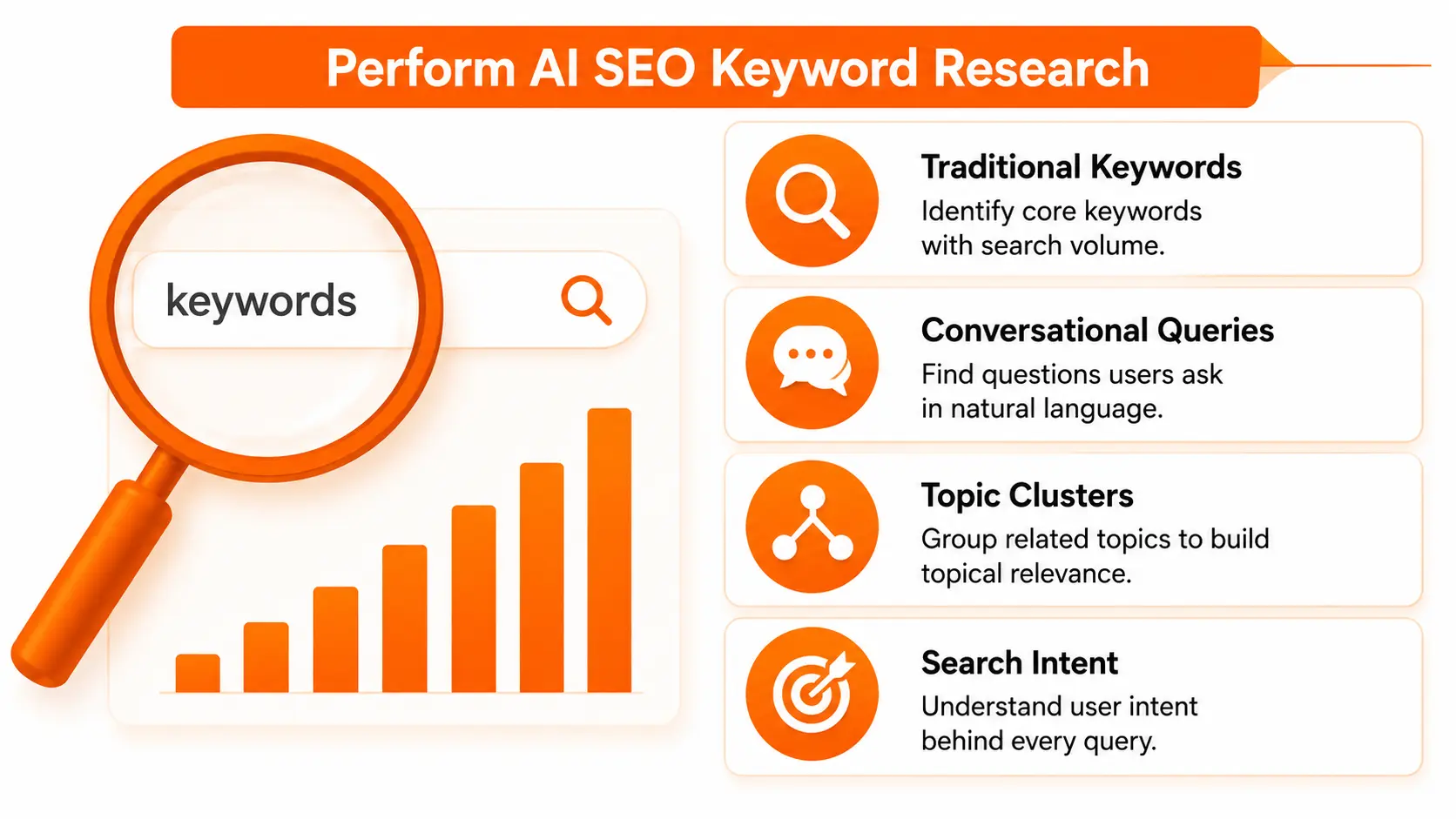
Keyword research remains the foundation of any successful SEO strategy, but AI SEO requires a broader approach. Traditional SEO focuses mainly on identifying keywords that users type into search engines, while AI SEO focuses on understanding the complete range of questions, conversations, and information needs behind those searches.
When users interact with AI assistants, they often use longer, more conversational queries and expect detailed answers. Therefore, businesses need to identify not only high-volume keywords but also the questions, comparisons, and decision-making factors that influence AI-generated recommendations.
A strong AI SEO keyword research process includes analyzing traditional keywords, conversational queries, and related topic clusters to understand the complete search landscape.
Identify Traditional Search Keywords
Traditional search keywords still play an important role in AI SEO because AI systems also analyze website content, topics, and relevance signals. A strong keyword foundation helps businesses create content that aligns with user demand while providing AI systems with clear context about their expertise.
The first step is identifying the different types of keywords related to your business, services, and industry.
Primary Keywords
Primary keywords represent the main topics or services you want your website to be associated with.
These keywords usually have higher search volume and define the core focus of a page.
Examples:
For an SEO agency:
- SEO company
- SEO services
- SEO agency
- Search engine optimization services
For an IT company:
- Managed IT services
- Cybersecurity services
- Cloud migration services
Primary keywords help search engines and AI systems understand the main subject of your content.
Secondary Keywords
Secondary keywords are related terms that provide additional context around your main topic.
They help create more comprehensive content by covering different aspects of the same subject.
Example:
Primary keyword:
SEO company
Related secondary keywords:
- SEO experts
- SEO consultant
- SEO strategy
- Organic traffic growth
- Search rankings
- SEO campaigns
Including relevant secondary keywords naturally helps AI systems understand the depth and relevance of your content.
Long-Tail Keywords
Long-tail keywords are more specific search queries that usually reflect stronger user intent.
These queries are especially important for AI SEO because users often ask AI tools detailed questions instead of searching with short keywords.
Examples:
Traditional keyword:
SEO company
Long-tail keywords:
- Best SEO company for small businesses
- Affordable SEO services for startups
- How much does SEO cost for a small business?
- SEO company with healthcare industry experience
Long-tail keywords help businesses create content that answers specific user needs and improves visibility for conversational searches.
Industry-Specific Keywords
Every industry has unique terms, challenges, and customer questions. AI systems consider industry relevance when recommending businesses, so creating industry-focused content is essential.
Examples:
Healthcare SEO
- SEO for doctors
- Healthcare marketing strategies
- Medical practice SEO
Legal SEO
- SEO for law firms
- Lawyer marketing services
- Legal website optimization
Real Estate SEO
- Real estate SEO company
- Real estate lead generation strategies
- Property website optimization
Industry-specific keywords help establish topical authority and show AI systems that your business has expertise in a particular field.
Traditional SEO Keyword vs AI SEO Query
The difference between traditional search and AI search is often the way users express their needs.
Traditional SEO keyword:
“SEO company”
AI SEO query:
“What is the best SEO company for small businesses?”
The AI query provides additional context, including:
- Target audience
- Buying intent
- Specific requirements
Businesses optimizing for AI search need to understand these additional layers behind user queries.
Research Conversational AI Queries
AI search is built around conversations. Users often ask complete questions instead of entering short keyword phrases.
To optimize for AI visibility, businesses should research the questions potential customers ask when looking for information, comparing solutions, or making purchase decisions.
Sources to Find Conversational Queries
Google People Also Ask
Google’s People Also Ask section provides valuable insights into common user questions.
Example:
Search:
“SEO services”
Related questions may include:
- What does an SEO company do?
- How much do SEO services cost?
- How long does SEO take?
- Is SEO worth it for small businesses?
These questions can become sections within your content.
ChatGPT Prompts
Analyzing common ChatGPT prompts helps identify how users interact with AI assistants.
Examples:
- “Recommend the best SEO agencies for startups”
- “How do I choose an SEO company?”
- “What should I look for in an SEO provider?”
These queries reveal the information users need before making decisions.
Perplexity Searches
AI search platforms like Perplexity show how users phrase research-based questions.
Examples:
- “Top SEO agencies for eCommerce businesses”
- “Best SEO companies with proven results”
- “SEO agencies specializing in healthcare”
These searches can help identify recommendation-based queries where businesses want to appear.
Reddit Discussions and Forums
Online communities provide real-world insights into customer concerns, problems, and decision-making processes.
Platforms like Reddit, industry forums, and community discussions reveal:
- Common complaints
- Frequently asked questions
- Buying concerns
- Comparison topics
Example:
Users may ask:
- “Is hiring an SEO agency worth it?”
- “How much should I pay for SEO?”
- “SEO agency vs freelancer—which is better?”
These discussions can inspire highly relevant AI-focused content.
Search Suggestions
Google autocomplete suggestions reveal popular ways users complete their searches.
Example:
Typing:
“SEO company…”
May show:
- SEO company near me
- SEO company pricing
- SEO company for small business
- SEO company reviews
These suggestions help identify additional content opportunities.
Build Query Fan-Out Maps
One of the biggest differences between traditional SEO and AI SEO is that AI systems do not treat a query as a single keyword. Instead, they understand the broader topic and connect related questions, concepts, and entities.
This process is often called query fan-out.
Query fan-out means expanding one main search query into multiple related questions that users may ask during their research journey.
Example: Query Fan-Out for “Best SEO Company”
A traditional SEO approach may focus only on ranking for:
Best SEO company
An AI SEO approach expands this topic into multiple related queries:
Selection Queries
- How to choose an SEO company?
- What makes a good SEO agency?
- What should businesses look for in an SEO provider?
Comparison Queries
- SEO company vs freelancer
- In-house SEO team vs SEO agency
- Cheap SEO services vs professional SEO services
Pricing Queries
- SEO agency pricing
- How much does SEO cost?
- What factors affect SEO pricing?
Industry-Specific Queries
- Best SEO company for healthcare businesses
- Best SEO agency for SaaS companies
- SEO services for small businesses
Trust-Based Queries
- SEO companies with proven results
- SEO agencies with case studies
- Award-winning SEO companies
Create Content That Covers the Complete Topic Ecosystem
AI systems prefer content that provides comprehensive answers rather than only targeting one keyword.
Instead of creating a page that only explains “SEO services,” businesses should cover the complete topic ecosystem:
- What SEO services include
- How SEO works
- SEO pricing
- SEO process
- Expected results
- Industry-specific solutions
- Case studies
- Common questions
- Comparison guides
This approach helps AI systems understand the depth of your expertise and increases the chances of your content being selected as a trusted source.
By combining traditional keyword research with conversational queries and query fan-out analysis, businesses can create content that matches both search engine algorithms and the way users interact with AI-powered search platforms.
Step 2: Analyze Competitors for AI SEO Opportunities
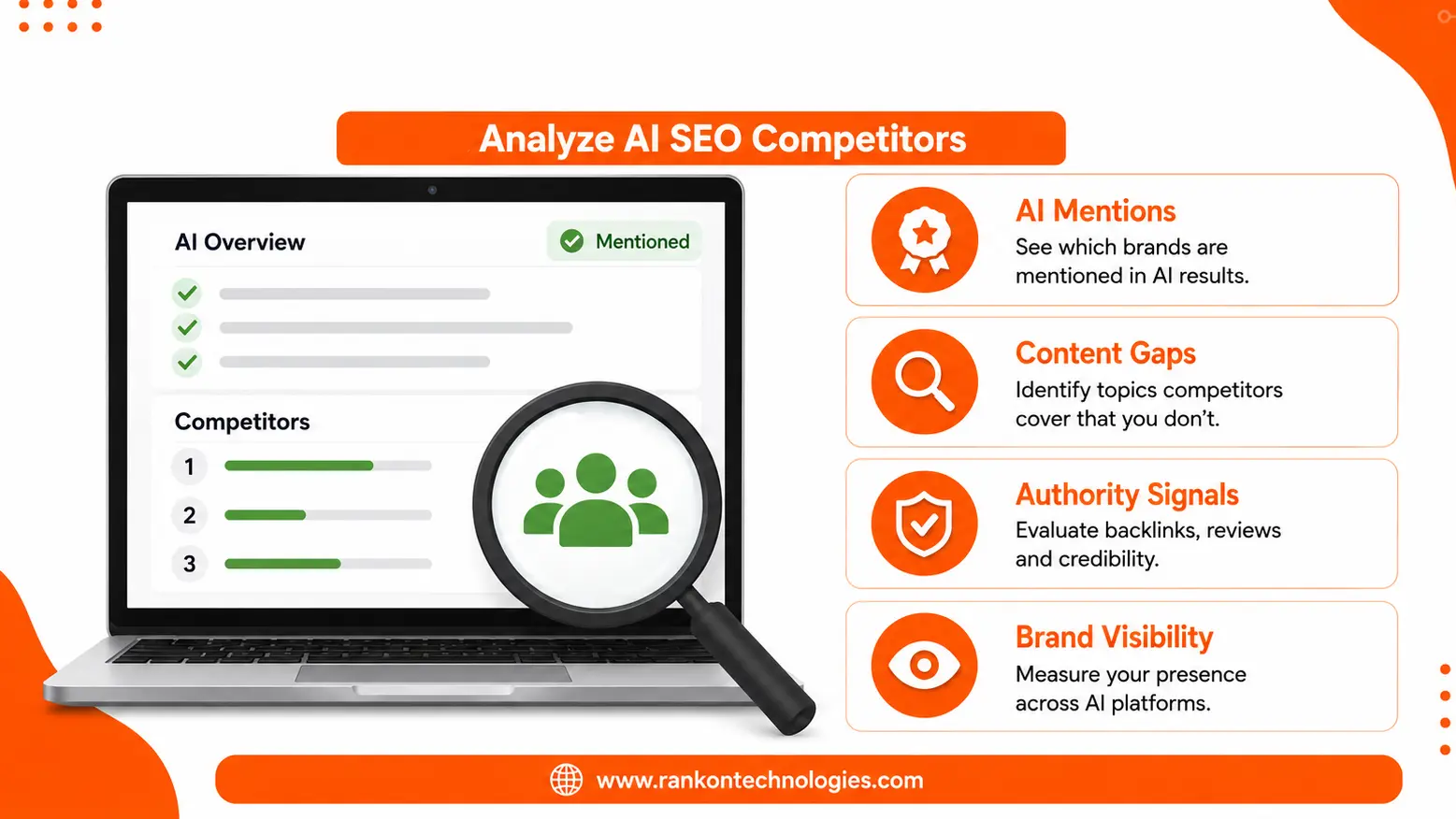
Competitor analysis is an important part of AI SEO because AI platforms do not only evaluate individual pages. They analyze overall brand authority, expertise, relevance, and trust signals when selecting sources for AI-generated answers.
By studying competitors that already appear in AI responses, businesses can understand what signals AI systems value and identify opportunities to improve their own visibility.
A strong AI SEO competitor analysis helps answer questions such as:
- Why are competitors being recommended by AI platforms?
- What topics and questions do they cover better?
- Which authority signals are helping them gain visibility?
- What opportunities are missing from your website?
Identify Competitors Appearing in AI Results
The first step is identifying which competitors are already gaining visibility in AI-generated search results.
Unlike traditional SEO competitor research, AI SEO analysis focuses on brands that appear in recommendations, citations, and AI-generated answers.
Analyze Which Brands Appear in ChatGPT Responses
Start by testing relevant customer queries on AI platforms such as ChatGPT.
Examples:
- “Best SEO companies for small businesses”
- “Top SEO agencies for healthcare businesses”
- “Which SEO company has the best results?”
Analyze:
- Which brands are mentioned?
- Are they mentioned consistently across different prompts?
- What information does AI associate with these brands?
- Are their websites, reviews, or third-party mentions influencing recommendations?
Look for patterns in how AI describes competitors.
For example, AI may associate a company with:
- Industry expertise
- Years of experience
- Specific services
- Locations served
- Awards
- Client results
These insights help identify the positioning signals your business needs to strengthen.
Analyze Companies Cited by Google AI Overviews
Google AI Overviews often provide summarized answers with links to supporting sources.
Analyze:
- Which websites are cited?
- What type of content receives citations?
- Are citations coming from service pages, blogs, research articles, or external publications?
- What topics do these pages cover?
For example, if competitors consistently receive citations for:
- Detailed guides
- Industry research
- Comparison articles
- Expert resources
it indicates the type of content Google considers valuable for that topic.
Identify Websites Ranking for Conversational Queries
Traditional keyword rankings are not enough for AI SEO. Businesses should analyze websites appearing for conversational searches.
Examples:
Traditional query:
“SEO services”
Conversational queries:
- “How much does SEO cost for a small business?”
- “What should I look for in an SEO agency?”
- “Which SEO company specializes in healthcare?”
Analyze competitor pages ranking for these queries and identify:
- Content format
- Page structure
- Topics covered
- FAQs included
- Expertise demonstrated
This helps reveal what type of content performs well for AI-driven search experiences.
Perform Content Gap Analysis
After identifying competitors appearing in AI results, the next step is finding content opportunities your website is missing.
Content gap analysis helps discover topics, questions, and resources that competitors cover but your website does not.
The goal is not to copy competitors but to identify areas where you can create more useful, detailed, and authoritative content.
Find Topics Competitors Cover
Analyze competitor websites to identify:
- Blog topics
- Service pages
- Industry guides
- Educational resources
- Research content
Example:
A competitor may have:
- SEO for healthcare businesses
- SEO pricing guide
- SEO case studies
- Local SEO checklist
while your website only has a general SEO services page.
These missing topics represent opportunities to expand your topical authority.
Identify Questions Competitors Answer
AI search relies heavily on question-based content.
Analyze competitor content to find:
- FAQs
- How-to guides
- Comparison sections
- Educational articles
Examples:
Missing questions may include:
- How long does SEO take?
- How much do SEO services cost?
- Should businesses hire an SEO agency?
- What SEO strategy works best for startups?
Creating content around these questions increases the chances of being recognized as a helpful source by AI systems.
Analyze Industry Pages Competitors Created
AI systems often prefer specialized content because it demonstrates expertise in specific areas.
Review whether competitors have created:
- Industry-specific service pages
- Location pages
- Solution pages
- Customer-focused landing pages
Examples:
Instead of only:
“SEO Services”
Competitors may create:
- SEO for Healthcare
- SEO for Law Firms
- SEO for Real Estate Companies
- SEO for SaaS Businesses
These pages help AI systems understand industry relevance.
Review Resources Competitors Publish
Resource libraries often strengthen brand authority.
Analyze competitor resources such as:
- Complete guides
- Whitepapers
- Research reports
- Case studies
- Checklists
- Templates
- Webinars
These assets provide valuable information that AI systems can reference when answering user questions.
Identify Missing Content Opportunities
After analyzing competitors, identify gaps where your website can provide better information.
Missing FAQs
FAQs help answer specific user questions and improve AI understanding.
Identify questions competitors answer but your website does not.
Examples:
- What does SEO cost?
- How long does SEO take?
- What SEO services are included?
- How do I choose an SEO agency?
Missing Comparison Content
Comparison content is valuable because users often research alternatives before making decisions.
Examples:
- SEO agency vs freelancer
- SEO vs PPC
- Local SEO vs traditional SEO
- In-house SEO team vs SEO agency
AI systems frequently receive comparison-based queries, making this content valuable for AI visibility.
Missing Industry Solutions
Industry-specific pages demonstrate expertise and relevance.
Examples:
- SEO for healthcare companies
- SEO for legal firms
- SEO for eCommerce businesses
- SEO for local businesses
These pages help AI systems connect your brand with specific customer needs.
Missing Expert Content
AI platforms increasingly value content that demonstrates real experience.
Look for opportunities to create:
- Expert opinions
- Case studies
- Original research
- Industry insights
- First-hand experiences
Content based only on general information may struggle to stand out compared to expert-driven resources.
Analyze Competitor Authority Signals
AI systems evaluate more than website content. They also consider external signals that indicate whether a brand is trustworthy and recognized within its industry.
Analyzing competitor authority signals helps identify where they have stronger digital credibility.
Backlinks
Backlinks remain an important authority signal.
Analyze:
- Number of referring domains
- Quality of linking websites
- Industry relevance of backlinks
- Content earning links
Look for patterns:
- Are competitors featured in industry publications?
- Do they receive links from authoritative websites?
- Are their guides being referenced by others?
Brand Mentions
AI systems can use brand mentions across the web as trust signals.
Analyze competitor mentions in:
- News websites
- Industry blogs
- Expert roundups
- Business directories
- Partner websites
A brand frequently mentioned across trusted sources is more likely to be recognized as an established entity.
Reviews and Reputation
Reviews influence how AI systems understand brand trust and customer satisfaction.
Analyze:
- Google reviews
- Clutch reviews
- G2 reviews
- Industry-specific review platforms
- Customer testimonials
Look at:
- Review quantity
- Review quality
- Common customer feedback themes
Awards and Recognitions
Awards provide additional credibility signals.
Analyze competitor recognition such as:
- Industry awards
- Agency rankings
- Certifications
- Professional memberships
These trust signals can influence how AI systems perceive expertise and authority.
Partnerships
Partnerships demonstrate industry relationships and credibility.
Analyze:
- Technology partnerships
- Vendor certifications
- Strategic collaborations
- Industry associations
Examples:
- Google Partner status
- Software platform partnerships
- Technology certifications
Industry Publications
Being featured in authoritative publications can significantly strengthen brand visibility.
Analyze competitor presence in:
- Industry magazines
- Expert interviews
- Guest articles
- Research publications
- News coverage
These mentions help build the entity authority signals that AI platforms use when selecting reliable sources.
By analyzing competitors across AI visibility, content coverage, and authority signals, businesses can identify exactly where they need to improve. AI SEO competitor analysis is not about copying what competitors do—it is about understanding the signals that influence AI recommendations and creating stronger, more authoritative digital assets.
Step 3: Optimize Website Structure for AI Search
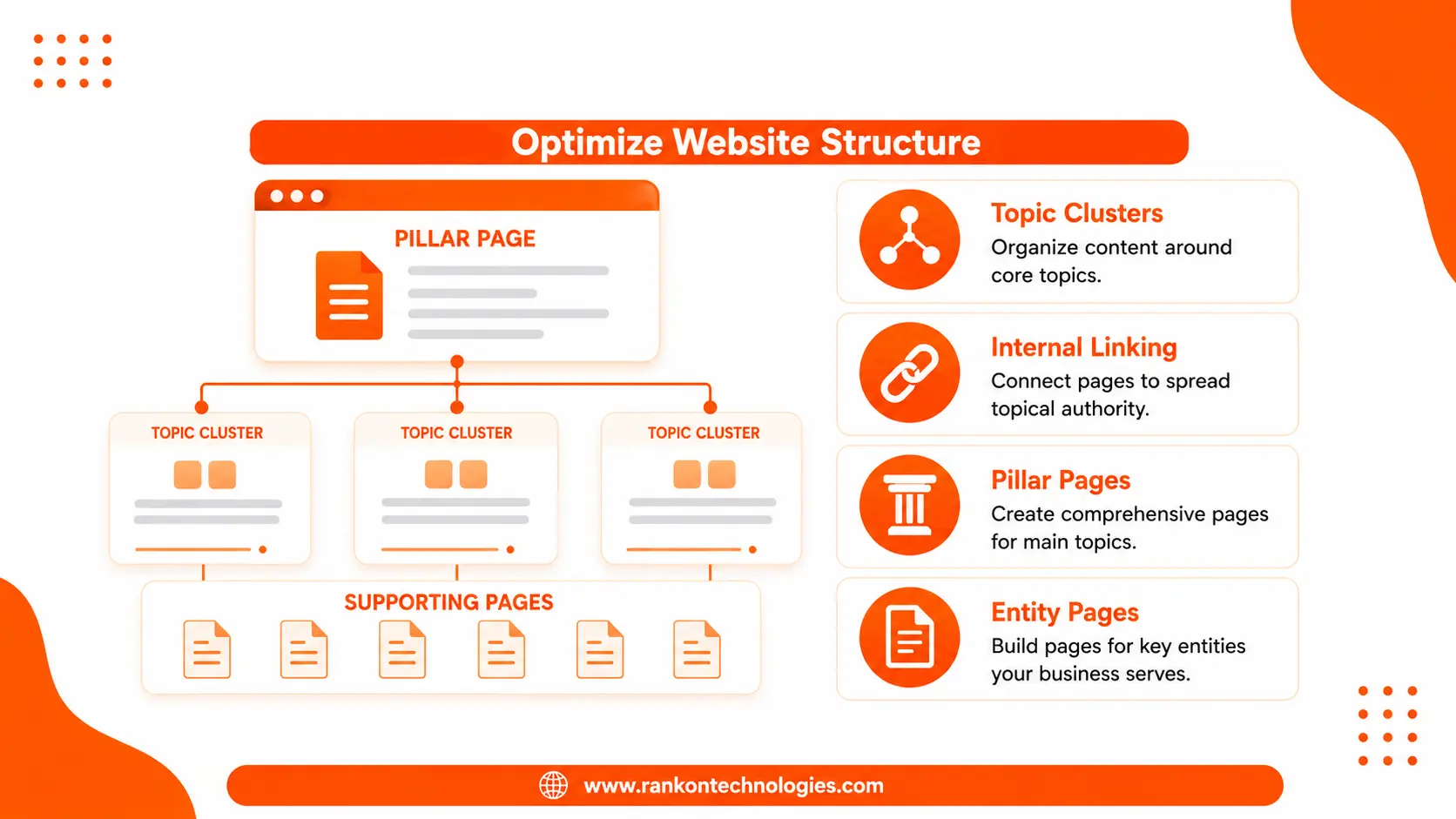
Website structure plays an important role in AI SEO because AI systems need to understand the relationships between your content, services, expertise, and brand information.
Unlike traditional search, where ranking a single page for a keyword may be the primary goal, AI search focuses on understanding the complete context behind a business. AI platforms analyze how different pages connect with each other, how clearly a website demonstrates expertise, and whether the brand provides comprehensive information around a topic.
A well-structured website helps AI systems:
- Understand your areas of expertise
- Connect related topics and services
- Identify important pages
- Recognize your brand as an authoritative source
- Provide accurate recommendations to users
Three important elements of an AI-friendly website structure include:
- Creating clear topic clusters
- Improving internal linking
- Building entity-focused pages
Create Clear Topic Clusters
Topic clusters help organize website content around a central subject. Instead of creating isolated pages, businesses create a connected ecosystem of content that covers a topic from multiple angles.
This approach helps search engines and AI systems understand that your website has comprehensive knowledge about a specific subject.
A typical topic cluster includes:
- A pillar page
- Supporting content
- Internal links connecting related pages
Pillar Pages
A pillar page is a comprehensive resource that covers the main topic or service in detail.
It acts as the central hub of a topic cluster and links to supporting content that explains specific subtopics.
A strong pillar page should:
- Provide a complete overview of the topic
- Answer common user questions
- Link to detailed supporting resources
- Demonstrate expertise and experience
Examples of pillar pages:
- SEO Services Guide
- Complete Technical SEO Guide
- Digital Marketing Guide
- AI SEO Guide
Supporting Content
Supporting content covers specific questions, subtopics, and related areas connected to the main pillar topic.
These pages help expand topical coverage and provide detailed answers for different user intents.
Supporting content may include:
FAQs
FAQs answer common customer questions and help AI systems understand user concerns.
Examples:
- How much does SEO cost?
- How long does SEO take?
- Is SEO worth investing in?
Guides
Detailed guides demonstrate expertise and provide educational value.
Examples:
- Technical SEO checklist
- Local SEO guide
- Link building strategies
- Content marketing guide
Case Studies
Case studies provide real-world experience and strengthen trust signals.
They demonstrate:
- Challenges faced
- Strategies implemented
- Results achieved
- Industry experience
AI systems can use these signals to better understand a company’s expertise.
Comparison Content
Comparison pages help answer decision-making queries.
Examples:
- SEO agency vs freelancer
- SEO vs PPC
- Local SEO vs traditional SEO
These content formats are especially useful because users often ask AI assistants comparison-based questions before making decisions.
Example: SEO Services Topic Cluster
Pillar Page:
SEO Services
This page covers:
- What SEO services include
- SEO process
- Benefits of SEO
- Industries served
- SEO pricing factors
Supporting Topics:
Technical SEO Guide
Covers:
- Crawlability
- Indexing
- Site speed
- Core Web Vitals
- Schema markup
Local SEO Guide
Covers:
- Google Business Profile optimization
- Local citations
- Reviews
- Location-based rankings
Link Building Strategies
Covers:
- Backlink acquisition
- Digital PR
- Authority building
- Outreach strategies
SEO Pricing Guide
Covers:
- SEO costs
- Pricing models
- Factors affecting investment
This connected structure helps AI systems understand that the website has expertise across the complete SEO ecosystem.
Improve Internal Linking
Proper Internal linking helps AI systems understand relationships between pages and identify which content is most important on your website.
A strong internal linking structure creates clear connections between:
- Services
- Blog content
- Guides
- Case studies
- Industry pages
It also helps distribute authority throughout the website.
Use Contextual Internal Links
Contextual links are links placed naturally within relevant content.
Example:
A blog discussing website performance can naturally link to:
- Technical SEO services
- Website audit services
- Core Web Vitals guide
These links provide additional resources for users and help AI systems understand topic relationships.
Use Descriptive Anchor Text
Anchor text provides context about the linked page.
Avoid generic anchor text such as:
- Click here
- Learn more
- Read this
Use descriptive anchors such as:
- Technical SEO services
- Local SEO strategies
- AI SEO guide
Clear anchor text helps search engines and AI systems understand what the destination page is about.
Connect Related Topics
AI systems analyze relationships between content pieces.
For example:
A page about SEO services should connect with related topics such as:
- Technical SEO
- Content marketing
- Local SEO
- Enterprise SEO
- SEO audits
This creates a stronger topical relationship and helps establish subject authority.
Pass Authority to Important Pages
Internal links help distribute page authority across your website.
Important pages such as:
- Service pages
- Conversion-focused landing pages
- Industry pages
should receive relevant internal links from:
- High-performing blog posts
- Resource pages
- Case studies
This helps AI systems identify which pages represent your core expertise.
Create Dedicated Entity-Focused Pages
AI search relies heavily on entities. An entity is a clearly identifiable person, business, product, service, or organization that AI systems can understand and associate with specific topics.
Creating dedicated entity-focused pages helps AI platforms build a stronger understanding of your brand.
About Company Page
Your About page helps establish your business entity.
Include:
- Company history
- Years of experience
- Industries served
- Team information
- Awards
- Certifications
- Achievements
Example:
Instead of simply saying:
“We provide SEO services.”
Explain:
“RankON Technologies is an SEO agency with 14+ years of experience, 500+ completed SEO projects, and expertise across healthcare, legal, financial, real estate, and other industries.”
Specific information helps AI systems understand your brand identity.
Service Pages
Dedicated service pages help AI associate your company with specific solutions.
Examples:
- SEO Services
- Technical SEO Services
- Local SEO Services
- Content Marketing Services
- Enterprise SEO Services
Each service page should clearly explain:
- What the service includes
- Who it is for
- Benefits
- Process
- Expertise
- Results
Location Pages
Location pages help businesses improve visibility for location-based AI queries.
Examples:
- SEO company in USA
- SEO agency in Australia
- SEO services for businesses in UK
These pages should include:
- Location-specific information
- Local experience
- Customer examples
- Relevant business details
Team and Expert Pages
AI systems increasingly value expertise signals.
Team pages should highlight:
- Professionals
- Experience
- Expertise areas
- Certifications
- Industry contributions
Expert profiles help strengthen trust and demonstrate real-world knowledge.
Case Studies
Case studies provide evidence of experience and results.
Include:
- Client industry
- Business challenge
- SEO strategy
- Implementation process
- Results achieved
They help AI systems understand your practical expertise in specific industries.
Author Pages
For content-driven websites, author pages help establish content credibility.
Include:
- Author background
- Experience
- Expertise
- Published content
- Professional profiles
This supports stronger trust signals, especially for topics where expertise matters.
By creating a clear website structure with topic clusters, strong internal linking, and entity-focused pages, businesses can make it easier for AI systems to understand who they are, what they offer, and why they should be considered a trusted source. A well-organized website is not only better for traditional SEO but also essential for long-term visibility in AI-powered search.
Step 4: Perform an AI SEO Content Audit
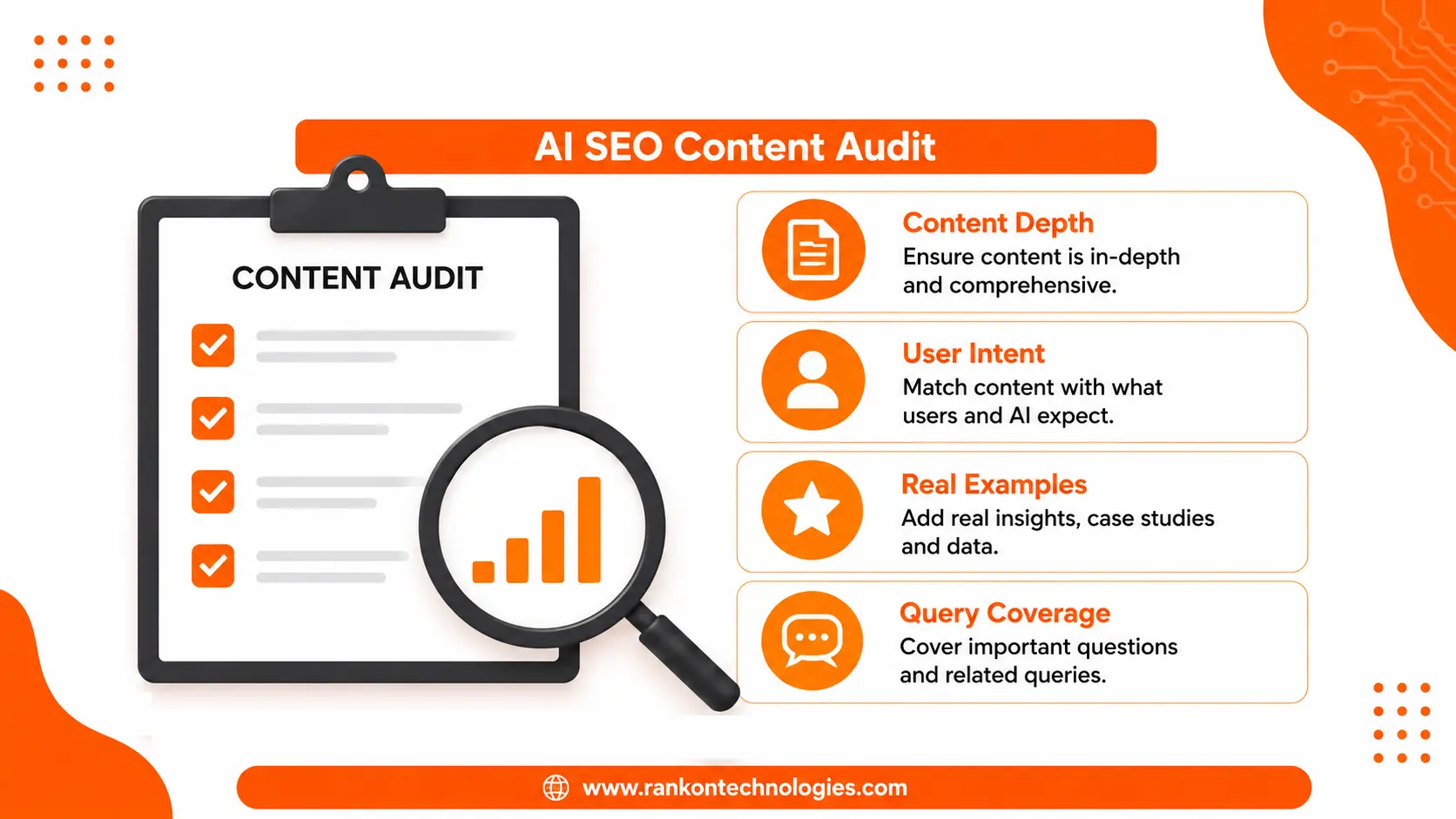
Content plays one of the most important roles in AI SEO because AI systems rely on high-quality information to generate answers, recommendations, and summaries.
However, optimizing content for AI search is not only about adding more keywords or increasing word count. AI platforms evaluate whether content is comprehensive, trustworthy, well-structured, and created by a knowledgeable source.
An AI SEO content audit helps identify whether your existing content:
- Fully answers user questions
- Demonstrates expertise and experience
- Covers related search intents
- Provides unique insights
- Builds trust and authority
A strong AI SEO content audit should analyze content depth, narrative structure, perspective, sentiment, and query coverage.
Analyze Content Depth and Completeness
AI search engines prefer content that provides complete answers rather than pages that only address a single keyword.
A common mistake businesses make is creating content around one search term without covering the broader topic ecosystem.
For example:
A traditional SEO article may target:
“SEO services”
But an AI-focused content approach should also answer:
- What are SEO services?
- What does an SEO agency do?
- How much do SEO services cost?
- How long does SEO take?
- What results can businesses expect?
- How do businesses choose an SEO company?
Comprehensive content increases the chances of being recognized as a reliable source by AI systems.
Check If Content Answers the Main Query
Every piece of content should clearly address the primary user intent.
Review:
- Does the introduction answer the user’s main question?
- Is the purpose of the content clear?
- Does the page provide actionable information?
Example:
If the topic is:
“How much does SEO cost?”
The content should immediately explain:
- Average SEO pricing
- Factors affecting cost
- Different pricing models
- What businesses should expect from an SEO investment
Check If Content Answers Related Questions
AI systems often expand user queries into related questions before generating answers.
Your content should cover supporting questions users may have.
For example:
Main topic:
Technical SEO Audit
Related questions:
- What does a technical SEO audit include?
- How much does a technical SEO audit cost?
- Which tools are used for technical SEO audits?
- How often should a website be audited?
Including related questions improves topical coverage.
Include Real Examples
Examples help AI systems understand practical applications and make content more valuable for users.
Instead of only explaining concepts, include:
- Real scenarios
- Industry examples
- Before-and-after examples
- Use cases
- Data points
Example:
Weak:
“Internal linking improves SEO performance.”
Strong:
“By creating topic clusters and internally linking supporting blogs to service pages, businesses can help search engines understand content relationships and improve page discoverability.”
Provide Unique Insights
AI platforms have access to large amounts of information. Generic content provides little reason for AI systems to prioritize your website.
To stand out, content should include:
- Original observations
- Expert opinions
- Research findings
- Case studies
- Real-world experiences
Unique insights demonstrate expertise and improve content credibility.
Optimize Content Narrative
AI systems prefer well-structured information because it helps them understand context, relationships, and meaning.
A clear content narrative improves both user experience and AI understanding.
Instead of presenting random information, content should follow a logical journey:
Problem → Explanation → Solution → Action
Create a Clear Introduction
The introduction should immediately explain:
- What the topic is
- Why it matters
- What readers will learn
Avoid generic introductions that do not provide context.
Weak:
“SEO is an important part of digital marketing.”
Better:
“AI search is changing how users discover businesses. Companies now need to optimize their content not only for search rankings but also for AI-generated recommendations.”
Maintain Logical Content Flow
Organize content in a way that follows user thinking.
A strong structure usually includes:
- Definition
- Importance
- Process
- Examples
- Best practices
- Common mistakes
- FAQs
This structure helps users and AI systems understand the topic clearly.
Use Problem → Solution Format
AI-generated answers often focus on solving user problems.
Content should clearly explain:
- The problem users face
- Why the problem occurs
- How to solve it
- Recommended actions
Example:
Problem:
“Website traffic has dropped.”
Explanation:
“Technical SEO issues, indexing problems, or algorithm changes may affect visibility.”
Solution:
“Conduct a technical SEO audit to identify and resolve issues.”
Add Real-World Examples
Examples improve content clarity and demonstrate practical experience.
Include:
- Client examples
- Industry examples
- Use cases
- Implementation scenarios
AI systems are more likely to recognize content that demonstrates practical knowledge.
Provide Step-by-Step Explanations
Step-by-step content performs well because it directly matches how users seek help.
Examples:
- How to perform a technical SEO audit
- How to optimize content for AI search
- How to build topic clusters
Detailed processes demonstrate expertise and improve content usefulness.
Optimize Perspective and Sentiment
AI systems increasingly evaluate not only what information is provided but also who is providing it and how trustworthy the source appears.
Two important factors are:
- Content perspective
- Brand sentiment
Content Perspective
AI platforms value content that demonstrates first-hand knowledge and real expertise.
Generic information is easier to produce, while experience-based content provides stronger credibility signals.
AI-friendly content should include:
First-Hand Experience
Share insights gained through actual work.
Examples:
- Projects completed
- Strategies tested
- Industry observations
- Lessons learned
Expert Opinions
Include perspectives from professionals with relevant experience.
Examples:
- Expert commentary
- Professional recommendations
- Industry predictions
Case Studies
Case studies provide proof that your expertise is based on real experience.
Include:
- Client challenge
- Strategy used
- Implementation process
- Results achieved
Original Research
Original data makes content more valuable.
Examples:
- Industry surveys
- Internal analysis
- Campaign findings
- Performance insights
Example:
Weak:
“SEO is important for businesses.”
Strong:
“Our SEO team analyzed 500+ websites and found that businesses with strong technical foundations and comprehensive content strategies achieved better long-term organic visibility.”
The second example demonstrates experience, expertise, and original insight.
Brand Sentiment
AI systems also consider reputation signals when understanding whether a business is trustworthy.
Brand sentiment is influenced by:
Reviews
Customer reviews provide signals about:
- Service quality
- Customer satisfaction
- Reliability
Customer Feedback
Testimonials and customer experiences help AI systems understand how people perceive a brand.
Online Discussions
AI platforms may analyze discussions across:
- Forums
- Communities
- Industry platforms
Positive discussions can strengthen brand credibility.
Brand Mentions
Mentions from trusted websites, publications, and industry sources help establish authority.
Positive brand sentiment improves trust signals and increases the likelihood of being recommended by AI systems.
Use Query Fan-Out Content Strategy
AI search does not treat queries as isolated keywords. Instead, AI systems understand related questions and concepts connected to the user’s intent.
A query fan-out content strategy involves creating content that covers multiple related questions around one main topic.
Example:
Main Query:
“Best SEO company”
Related questions:
FAQs
- How do I choose an SEO company?
- How much do SEO services cost?
- How long does SEO take?
Related Questions
- What services does an SEO company provide?
- What results can SEO deliver?
Comparison Sections
- SEO agency vs freelancer
- SEO vs paid advertising
Definitions
- What is SEO?
- What is technical SEO?
- What is local SEO?
Examples
- SEO case studies
- Industry-specific SEO examples
Alternatives
- In-house SEO team vs agency
- SEO tools vs professional services
Covering these related topics creates a complete information resource that AI systems can better understand and reference.
Develop an AI SEO Content Workflow
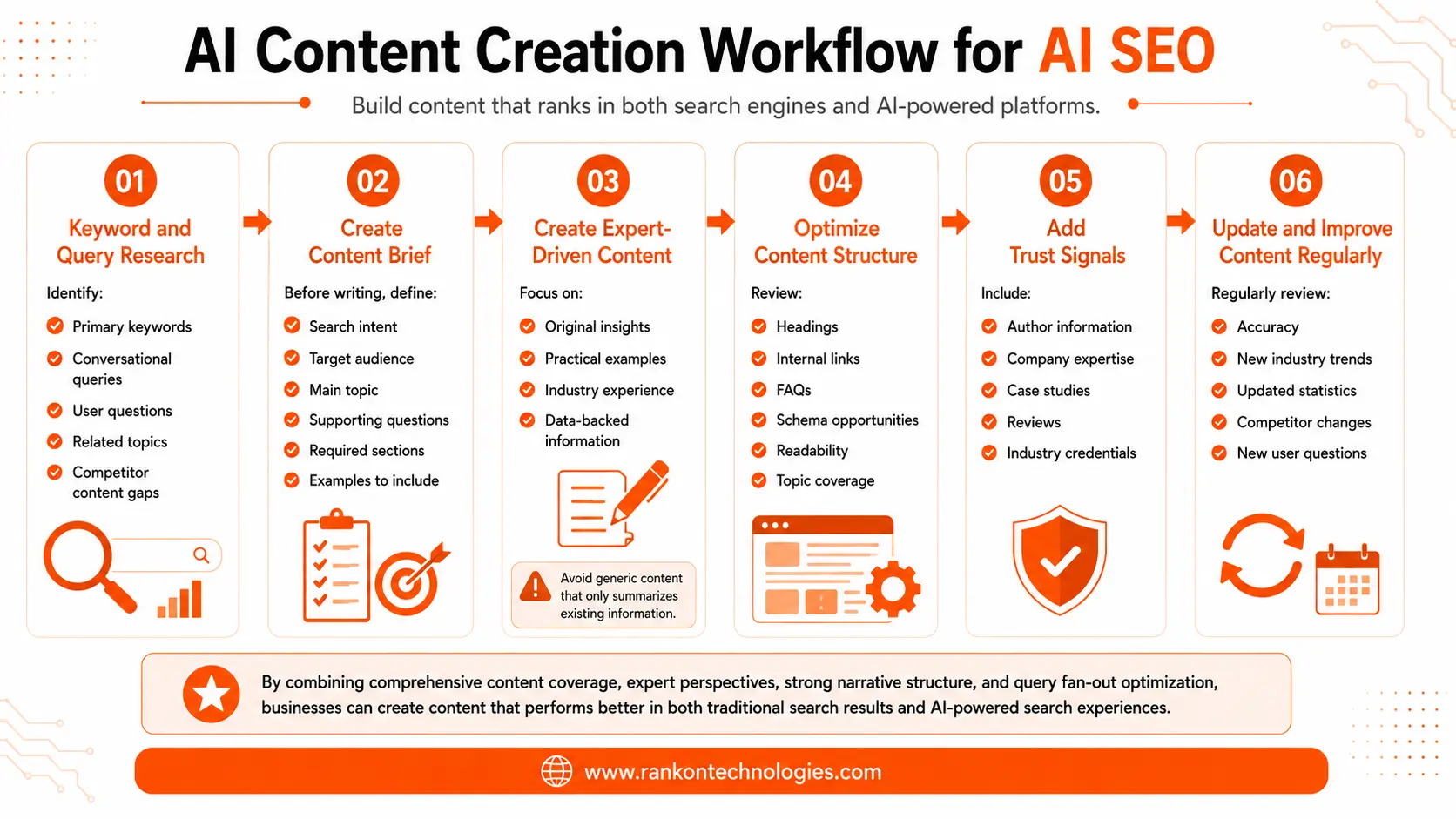
AI SEO requires a structured content workflow rather than publishing content randomly.
A strong workflow includes:
Step 1: Keyword and Query Research
Identify:
- Primary keywords
- Conversational queries
- User questions
- Related topics
- Competitor content gaps
Step 2: Create Content Brief
Before writing, define:
- Search intent
- Target audience
- Main topic
- Supporting questions
- Required sections
- Examples to include
Step 3: Create Expert-Driven Content
Focus on:
- Original insights
- Practical examples
- Industry experience
- Data-backed information
Avoid creating generic content that only summarizes existing information.
Step 4: Optimize Content Structure
Review:
- Headings
- Internal links
- FAQs
- Schema opportunities
- Readability
- Topic coverage
Step 5: Add Trust Signals
Include:
- Author information
- Company expertise
- Case studies
- Reviews
- Industry credentials
Step 6: Update and Improve Content Regularly
AI search continues to evolve, and outdated content may lose visibility.
Regularly review:
- Accuracy
- New industry trends
- Updated statistics
- Competitor changes
- New user questions
By combining comprehensive content coverage, expert perspectives, strong narrative structure, and query fan-out optimization, businesses can create content that performs better in both traditional search results and AI-powered search experiences.
Step 5: Optimize On-Page SEO for AI Search
On-page SEO remains an essential part of AI SEO because AI systems need clear, well-organized, and meaningful content to understand a webpage’s purpose, expertise, and relevance.
While traditional on-page SEO focuses on optimizing pages for keywords and rankings, AI SEO requires a broader approach. Content should not only include relevant terms but also provide complete answers, demonstrate expertise, and make information easy for AI systems to interpret.
A strong AI-focused on-page SEO strategy combines:
- Comprehensive content optimization
- Clear information structure
- Proper optimization of important page elements
Content Optimization
AI search systems prioritize content that is useful, accurate, and provides complete answers to user queries.
When optimizing content for AI search, focus on creating resources that answer user needs rather than simply targeting keywords.
Use Clear Headings
Headings help users and AI systems understand the structure and hierarchy of your content.
A well-organized heading structure should include:
- One clear H1 covering the main topic
- H2 sections covering major subtopics
- H3 sections explaining supporting points
Example:
H1: How to Do AI SEO
H2: AI SEO Keyword Research
H3: Research Conversational Queries
H3: Build Query Fan-Out Maps
Clear headings help AI systems identify important concepts and relationships within your content.
Ensure Complete Topic Coverage
AI systems prefer content that provides comprehensive information instead of incomplete answers.
Before publishing content, evaluate:
- Does it answer the main question?
- Does it cover related questions?
- Does it explain important concepts?
- Does it include examples?
- Does it address common concerns?
For example, an article about Technical SEO should not only explain the definition but also cover:
- Technical SEO checklist
- Crawlability
- Indexing
- Site speed
- Schema markup
- Common mistakes
- Audit process
Complete topic coverage increases the chances of your content being selected as a reliable AI source.
Use Keywords Naturally
Keywords still help AI systems understand the topic of your content, but keyword stuffing can reduce readability and trust.
Focus on:
- Primary keyword usage
- Related terms
- Topic-specific phrases
- Natural language variations
Example:
Instead of repeatedly using:
“AI SEO services”
Include related phrases:
- AI search optimization
- Generative Engine Optimization
- AI visibility
- Search optimization for AI platforms
- AI-powered search results
This creates stronger topical relevance.
Add Question-Based Sections
AI search is heavily driven by questions. Adding question-based sections helps align content with how users interact with AI assistants.
Examples:
- What is AI SEO?
- How does AI search work?
- How can businesses appear in ChatGPT recommendations?
- Does traditional SEO help with AI visibility?
FAQs and question-based sections increase the chances of matching conversational queries.
Keep Information Updated
AI systems prefer accurate and current information.
Regularly review content for:
- Outdated statistics
- Old examples
- Changed industry practices
- New technologies
- Updated recommendations
For topics like AI SEO, digital marketing, and technology, frequent updates are especially important because the search landscape changes quickly.
Include Expert Insights
AI systems increasingly value content that demonstrates real-world experience.
Strengthen content by including:
- Professional opinions
- Case studies
- Campaign insights
- Industry observations
- Original analysis
Example:
Generic:
“Content marketing helps businesses attract customers.”
Expert-driven:
“Our content team analyzed multiple SEO campaigns and found that topic clusters combined with strong internal linking improved content discoverability and organic visibility.”
Expert insights help demonstrate experience and authority.
Improve Content Structure
The way information is presented affects how easily AI systems can understand and extract useful information.
Well-structured content improves:
- User experience
- Content readability
- Information extraction
- AI understanding
Use Short Paragraphs
Long blocks of text make content difficult to read and harder for AI systems to process.
Best practices:
- Keep paragraphs focused on one idea
- Use 2–4 sentence paragraphs where possible
- Break complex topics into smaller sections
Use Lists
Lists help organize information clearly.
Examples:
Benefits of AI SEO:
- Improve AI visibility
- Increase brand mentions
- Reach customers earlier
- Build authority
Lists make important information easier for both users and AI systems to identify.
Use Tables
Tables are useful for presenting comparisons and structured information.
Examples:
| Traditional SEO | AI SEO |
| Focuses on rankings | Focuses on AI visibility |
| Keyword-focused | Intent-focused |
| Search results pages | AI-generated answers |
Tables help AI systems understand relationships between different concepts.
Add FAQs
FAQs are one of the most effective formats for AI search optimization.
They help answer specific user queries and provide clear information.
Examples:
- How long does AI SEO take?
- Can small businesses benefit from AI SEO?
- What content works best for AI search?
FAQ sections also create opportunities to target conversational searches.
Include Definitions
Clear definitions help AI systems understand important concepts.
Example:
Instead of assuming users understand:
“Entity SEO”
Provide:
“Entity SEO is the process of optimizing online information so search engines and AI systems can better understand and connect a brand, person, product, or service.”
Definitions improve topical clarity.
Add Examples
Examples make concepts easier to understand and provide practical context.
Include:
- Industry examples
- Use cases
- Before-and-after scenarios
- Implementation examples
AI systems value content that explains not only what something is but also how it applies in real situations.
Optimize Important Page Elements
Beyond content, important on-page elements help AI systems understand page purpose, relevance, and relationships.
Optimize Title Tags
Title tags should clearly describe the page topic.
Best practices:
- Include the primary topic naturally
- Keep titles clear and specific
- Match search intent
Example:
Weak:
“SEO Guide”
Better:
“AI SEO Guide: How to Optimize Your Website for AI Search in 2026”
Optimize Meta Descriptions
Meta descriptions summarize page content and encourage users to visit.
Include:
- Main topic
- Value proposition
- Relevant keywords naturally
Example:
“Learn how AI SEO works and discover strategies to improve your website visibility in ChatGPT, Google AI Overviews, and AI-powered search platforms.”
Structure H1 and H2 Headings Properly
Headings provide content hierarchy.
Best practices:
- Use one H1 per page
- Use descriptive H2 sections
- Use H3 sections for supporting details
- Maintain logical flow
This helps AI systems understand the relationship between different sections.
Optimize Image Alt Text
Image alt text helps search engines understand visual content.
Good alt text should:
- Describe the image accurately
- Provide context
- Avoid keyword stuffing
Example:
Poor:
“AI SEO”
Better:
“SEO specialist analyzing AI search optimization strategy”
Add Internal Links
Internal links help AI systems understand content relationships.
Best practices:
- Link related topics naturally
- Use descriptive anchor text
- Connect supporting content with pillar pages
Example:
A blog about AI SEO can link to:
- Technical SEO services
- Content marketing services
- SEO services
Implement Schema Markup
Schema markup provides additional context about your website and content.
Useful schema types include:
- Organization Schema
- Article Schema
- FAQ Schema
- Service Schema
- Local Business Schema
- Review Schema
Schema helps AI systems better understand:
- Who you are
- What services you provide
- What your content represents
Step 6: Technical SEO Optimization for AI Search
Technical SEO is a critical component of AI SEO because AI systems need to access, crawl, and understand your website before they can use its information in search responses.
While content helps AI systems understand what your business offers, technical SEO helps them discover, interpret, and trust that information.
A technically optimized website improves:
- Search engine accessibility
- AI content discovery
- Entity understanding
- User experience
- Overall website reliability
Technical SEO optimization for AI search focuses on three key areas:
- Improving crawlability and indexability
- Implementing structured data
- Improving website performance
Improve Crawlability and Indexability
AI systems rely on search engine crawlers to discover website content. If important pages cannot be crawled or indexed properly, they may not appear in search results or be considered as sources for AI-generated answers.
A strong technical foundation ensures that AI systems can easily access and understand your website information.
Optimize XML Sitemap
An XML sitemap helps search engines discover important pages on your website.
For AI SEO, a clean and updated sitemap helps ensure that valuable content is easily accessible.
Best practices:
- Include only important, indexable pages
- Remove broken URLs
- Avoid including redirected pages
- Update the sitemap when new content is published
- Submit the sitemap through Google Search Console
Example pages to include:
- Service pages
- Product pages
- Blog articles
- Location pages
- Resource pages
A properly optimized sitemap improves content discoverability.
Optimize Robots.txt
The robots.txt file controls which parts of your website search engine crawlers can access.
Incorrect robots.txt settings can prevent important pages from being discovered.
Common mistakes:
- Blocking important service pages
- Blocking blog content
- Blocking JavaScript or CSS files
- Preventing crawler access unintentionally
Best practices:
- Allow access to valuable content
- Block only unnecessary sections
- Review robots.txt after website updates
- Test rules before implementation
A properly configured robots.txt file ensures AI systems and search engines can access your important information.
Use Correct Canonical Tags
Canonical tags help search engines understand which version of a page should be considered the primary version.
They are especially useful for websites with:
- Duplicate content
- Similar pages
- Product variations
- URL parameters
Common canonical mistakes:
- Pointing canonical tags to unrelated pages
- Using multiple canonical URLs
- Canonicalizing pages that should be indexed
Proper canonical implementation helps AI systems identify the correct source of information.
Implement Proper Redirects
Redirects help maintain website structure when URLs change.
Incorrect redirects can create crawling issues.
Common problems:
- Redirect chains
- Redirect loops
- Broken redirects
- Incorrect 302 redirects
Best practices:
- Use 301 redirects for permanent changes
- Redirect users and crawlers to the most relevant page
- Remove unnecessary redirect chains
A clean redirect structure improves website accessibility and content discovery.
Fix No-Index Issues
A noindex tag tells search engines not to include a page in search results.
While useful for private or unnecessary pages, accidental noindex implementation can hide valuable content.
Common issues:
- Important pages marked as noindex
- New pages not being indexed
- Incorrect CMS settings
Regularly check:
- Service pages
- Blog articles
- Landing pages
- Location pages
Ensuring important pages are indexable improves AI visibility opportunities.
Implement Structured Data
Structured data helps search engines and AI systems better understand the meaning of website content.
Instead of only reading text, AI systems can use schema markup to identify important entities such as:
- Businesses
- Services
- Products
- People
- Reviews
- Articles
Schema creates additional context and helps AI systems understand relationships between different information points.
For example:
Without schema:
“RankON Technologies provides SEO services.”
With schema:
AI systems can understand:
- RankON Technologies = Organization entity
- SEO services = Service entity
- Location = Business location
- Reviews = Trust signals
This improves entity understanding and helps AI platforms interpret website information more accurately.
Organization Schema
Organization Schema helps define your business entity.
It can provide information such as:
- Company name
- Logo
- Website
- Social profiles
- Contact details
It helps AI systems understand:
- Who your company is
- How your brand is represented online
- Related business information
Local Business Schema
Local Business Schema is important for businesses targeting location-based searches.
It helps communicate:
- Business name
- Address
- Service areas
- Opening hours
- Contact information
- Reviews
This improves visibility for queries such as:
- “Best SEO company near me”
- “SEO agency in [location]”
Service Schema
Service Schema helps search engines understand the services your business provides.
Include details such as:
- Service name
- Description
- Provider information
- Service area
Examples:
- SEO Services
- Technical SEO Services
- Local SEO Services
- AI SEO Services
This helps AI systems connect your brand with relevant service queries.
Article Schema
Article Schema helps AI systems understand blog content.
It provides context about:
- Article title
- Author
- Publishing date
- Updated date
- Main topic
This is especially useful for educational content, guides, and industry resources.
FAQ Schema
FAQ Schema helps identify question-and-answer content.
It is useful for pages containing:
- Common questions
- Service FAQs
- Educational explanations
Examples:
- What is AI SEO?
- How does technical SEO work?
- How much does SEO cost?
FAQ schema provides additional clarity about content structure.
Review Schema
Review Schema helps communicate reputation signals.
It can highlight:
- Customer ratings
- Reviews
- Testimonials
Reviews contribute to trust and can influence how AI systems evaluate business credibility.
Improve Website Performance
Website performance is an important technical SEO factor because AI search optimization is not only about being discovered—it is also about providing a reliable user experience.
A slow or poorly optimized website may create negative signals for both users and search engines.
Optimize Core Web Vitals
Core Web Vitals measure important aspects of website performance.
Key metrics include:
Largest Contentful Paint (LCP)
Measures loading performance.
Improve LCP by:
- Optimizing images
- Improving server response time
- Reducing unnecessary scripts
Interaction to Next Paint (INP)
Measures website responsiveness.
Improve INP by:
- Reducing JavaScript execution
- Optimizing interactive elements
- Improving code efficiency
Cumulative Layout Shift (CLS)
Measures visual stability.
Improve CLS by:
- Setting image dimensions
- Avoiding unexpected layout changes
- Optimizing page elements
Improve Mobile Optimization
AI search is increasingly accessed through mobile devices, making mobile optimization essential.
Common mobile issues include:
- Slow loading pages
- Poor navigation
- Small text
- Unresponsive design
- Difficult interactions
Best practices:
- Use responsive design
- Optimize mobile layouts
- Improve mobile page speed
- Test across devices
Improve Page Speed
Fast websites provide better user experiences and make content easier to access.
Common page speed improvements:
- Compress images
- Reduce unnecessary plugins
- Minify CSS and JavaScript
- Enable caching
- Improve hosting performance
- Optimize third-party scripts
Optimize JavaScript Rendering
Modern websites often use JavaScript frameworks, but excessive JavaScript can create challenges for search engines.
Common issues:
- Important content loaded only through JavaScript
- Slow rendering
- Blocked resources
- Poor crawler access
Best practices:
- Use server-side rendering where needed
- Ensure important content is available in HTML
- Reduce unnecessary JavaScript
- Test rendering using SEO tools
Technical SEO creates the foundation for AI search visibility. Without proper crawling, indexing, structured data, and website performance, even high-quality content may struggle to be discovered and understood by AI systems.
By improving technical SEO elements such as XML sitemaps, schema markup, Core Web Vitals, and website accessibility, businesses can make it easier for AI platforms to recognize their expertise and use their content as a trusted source.
Step 7: Build Entity SEO for AI Visibility
Entity SEO is becoming an important part of AI SEO because AI systems do not understand websites only through keywords. Instead, they try to understand the relationships between people, businesses, products, services, locations, and topics.
When users ask AI assistants for recommendations, the system needs to identify:
- Who the business is
- What services it provides
- Which industries it serves
- Whether it has expertise and authority
- How it is connected to other trusted entities
Building a strong brand entity helps AI platforms better understand your business and increases the chances of appearing in AI-generated answers, recommendations, and citations.
What Is Entity SEO?
Entity SEO is the process of optimizing online information so search engines and AI systems can clearly understand and recognize a specific entity.
An entity is a unique and identifiable subject that AI systems can understand and associate with specific information.
Examples of entities include:
- Companies
- People
- Products
- Services
- Locations
- Organizations
- Brands
Traditional SEO focuses heavily on keywords.
For example:
A website may optimize for:
“SEO services”
However, AI systems also need to understand:
- Which company provides SEO services?
- What experience does the company have?
- Which industries does it serve?
- Where is it located?
- What reputation signals support its expertise?
Entity SEO helps create these connections.
How AI Systems Understand Entities
AI platforms build an understanding of entities by analyzing information from multiple sources, including:
- Website content
- Structured data
- Business profiles
- Reviews
- Brand mentions
- Industry publications
- Author profiles
- External references
For example, an AI system may understand:
RankON Technologies
as:
- A digital marketing company
- Providing SEO services
- Having 14+ years of experience
- Serving global clients
- Working across multiple industries
- Having recognized industry presence
The more consistent and connected this information is across the web, the easier it becomes for AI systems to understand and trust the entity.
Strengthen Your Brand Entity
A strong brand entity requires consistent information, clear expertise signals, and structured data across your website and external platforms.
The goal is to make your business information accurate, complete, and recognizable.
Maintain Consistent Company Information
Consistency is essential for entity recognition.
Ensure your business information remains consistent across:
- Website
- Google Business Profile
- Business directories
- Social profiles
- Industry platforms
- Review websites
Important details include:
- Company name
- Address
- Phone number
- Website URL
- Services offered
- Business description
Inconsistent information can make it harder for AI systems to connect different references to the same business entity.
Optimize Your About Page
Your About page is one of the most important pages for building brand identity.
A strong About page should explain:
- Who your company is
- When the company started
- Areas of expertise
- Industries served
- Team experience
- Achievements
- Awards and recognition
Avoid generic descriptions.
Weak:
“We provide digital marketing solutions.”
Strong:
“RankON Technologies is an SEO and digital marketing agency with 14+ years of experience helping businesses improve organic visibility through technical SEO, content marketing, and AI-focused search strategies.”
Specific information helps AI systems better understand your company.
Create Expert Profiles
AI systems increasingly value expertise signals, especially for topics where trust matters.
Create detailed profiles for:
- Founders
- SEO specialists
- Content experts
- Industry professionals
Include:
- Professional background
- Experience
- Areas of expertise
- Certifications
- Published content
- Industry contributions
Expert profiles strengthen the connection between your brand and knowledgeable individuals.
Implement Organization Schema
Organization Schema provides structured information about your company.
It helps communicate:
- Business name
- Logo
- Website
- Social profiles
- Contact information
- Brand details
Schema markup helps AI systems understand that different online references belong to the same organization entity.
Build Knowledge Graph Signals
Search engines and AI systems use knowledge graph-style connections to understand entities and their relationships.
You can strengthen these signals through:
- Consistent business information
- Brand mentions
- Authoritative backlinks
- Industry profiles
- Reviews
- Expert content
- Structured data
The goal is to create a strong digital footprint where multiple trusted sources confirm the same business information.
Connect Related Entities
AI systems do not analyze entities in isolation. They understand relationships between different entities.
Creating meaningful connections helps AI understand your business ecosystem.
Brand → Services
Your brand should have clear connections with the services you provide.
Example:
Brand:
RankON Technologies
Connected services:
- SEO Services
- Technical SEO
- Local SEO
- Content Marketing
- AI SEO
Create dedicated service pages that clearly explain each offering.
This helps AI systems associate your brand with specific solutions.
Brand → Industry
AI systems need to understand which industries your business serves.
Create industry-focused content and pages such as:
- SEO for Healthcare
- SEO for Law Firms
- SEO for Real Estate
- SEO for Financial Companies
This helps AI answer industry-specific queries.
Example:
User query:
“Best SEO company for healthcare businesses”
A strong industry entity connection increases the chances of being considered relevant.
Brand → Experts
Connect your company with experienced professionals.
Examples:
- Founder profiles
- Author pages
- Team pages
- Expert contributions
This creates relationships between:
Company → People → Expertise
These connections help demonstrate experience and credibility.
Brand → Locations
Location signals are important for local and regional AI searches.
Connect your brand with relevant locations through:
- Location pages
- Google Business Profile
- Local directories
- Regional case studies
Example:
Brand:
SEO agency
Location connection:
- SEO company in USA
- SEO agency in Australia
- SEO services in UK
Brand → Case Studies
Case studies connect your brand with real-world experience.
They demonstrate:
- Industries worked with
- Problems solved
- Strategies implemented
- Results achieved
Example:
Brand:
RankON Technologies
Connected entities:
- Healthcare SEO case study
- Real estate SEO case study
- SaaS SEO project
These connections help AI systems understand your practical expertise.
Entity SEO helps businesses move beyond keyword optimization and build a recognizable digital identity.
In AI-driven search, visibility depends not only on having relevant content but also on helping AI systems understand who you are, what you do, who you serve, and why your business should be trusted.
By strengthening your brand entity, maintaining consistent information, implementing structured data, and building meaningful connections between related entities, businesses can improve their chances of appearing in AI recommendations and search experiences.
Step 8: Build Brand Mentions and Digital Authority
AI search systems do not evaluate websites based only on their own content. They also analyze how a brand is recognized across the wider web.
When AI platforms generate recommendations or answers, they look for signals that indicate whether a business is trustworthy, experienced, and recognized within its industry.
Brand mentions and digital authority help AI systems understand:
- Whether a business is a recognized entity
- How customers and industry professionals perceive the brand
- Whether other trusted sources validate its expertise
- Which topics and industries the brand is associated with
A strong AI SEO strategy should focus on building authority beyond your website through mentions, reviews, partnerships, and third-party recognition.
Earn Industry Mentions
Industry mentions are references to your brand on other trusted websites and platforms.
These mentions act as credibility signals because they show that your expertise is recognized outside your own website.
AI systems may analyze:
- Where your brand is mentioned
- Who is mentioning your business
- What context the mention appears in
- Which topics are associated with your brand
For example, a software company mentioned by multiple technology publications may be considered more authoritative than a company with only self-published content.
Industry Publications
Getting featured on relevant industry websites helps strengthen topical authority.
Examples:
- Marketing publications for digital agencies
- Healthcare publications for medical businesses
- Technology websites for software companies
Opportunities include:
- Expert interviews
- Guest articles
- Industry insights
- Research contributions
- Expert commentary
These mentions help AI systems associate your brand with specific expertise areas.
News Websites
News coverage can strengthen brand credibility and visibility.
Examples:
- Company announcements
- Industry achievements
- New product launches
- Awards and recognition
- Business milestones
News mentions provide external validation and can improve how AI systems perceive brand authority.
Expert Roundups
Expert roundups are articles where multiple professionals share opinions or recommendations about a topic.
Examples:
- “SEO experts share their top ranking strategies”
- “Digital marketing professionals discuss future trends”
- “Industry leaders recommend the best tools”
Being included in expert roundups helps establish:
- Industry expertise
- Professional recognition
- Brand association with specific topics
Partner Websites
Partnerships can create valuable authority signals.
Examples:
- Technology partners
- Business collaborations
- Industry associations
- Vendor partnerships
Partner websites can mention your brand through:
- Partner directories
- Case studies
- Success stories
- Collaboration announcements
These connections help strengthen entity relationships.
Business Directories
High-quality business directories can improve brand consistency and discoverability.
Examples:
- Industry-specific directories
- Professional associations
- Business listing platforms
Important information should remain consistent:
- Business name
- Website
- Services
- Location
- Contact details
Avoid low-quality directory submissions. Focus on relevant and trusted platforms.
Get Featured in Listicles and Comparison Articles
Listicles and comparison content play an important role in AI SEO because users frequently ask AI systems for recommendations.
Examples of AI queries:
- “What are the best SEO agencies?”
- “Which software providers are best for small businesses?”
- “Who are the top service providers in this industry?”
AI systems often analyze third-party articles, rankings, reviews, and comparison pages when generating recommendations.
Examples of Listicle Opportunities
Depending on your industry, opportunities may include:
Service Businesses
- Best SEO agencies
- Top digital marketing companies
- Best web development companies
Software Companies
- Best CRM platforms
- Top project management tools
- Best analytics software
Professional Services
- Best accounting firms
- Top legal service providers
- Leading consulting companies
Why Listicles Influence AI Recommendations
Listicles provide structured information that AI systems can easily interpret.
For example, an article titled:
“Top 10 SEO Agencies for Small Businesses”
clearly communicates:
- Industry category
- Business type
- Ranking context
- Brand relationships
When multiple trusted sources consistently mention a brand in relevant lists, AI systems may develop stronger associations between:
Brand → Industry → Service → Expertise
This can increase the likelihood of appearing in AI-generated recommendations.
How to Improve Chances of Being Featured
Businesses can increase listicle opportunities by:
- Building strong industry relationships
- Creating unique expertise-driven content
- Publishing case studies
- Showcasing achievements
- Maintaining strong reviews
- Creating recognizable brand assets
Instead of only requesting placements, focus on becoming a brand that industry websites naturally want to reference.
Strengthen Reviews and Reputation
Reviews are important trust signals for both customers and AI systems.
AI platforms need to understand not only what a business claims about itself but also how customers and third-party platforms perceive it.
A strong reputation profile includes:
- Positive customer feedback
- Consistent ratings
- Detailed testimonials
- Industry recognition
Google Reviews
Google reviews are especially important for local and service-based businesses.
Focus on:
- Collecting genuine customer reviews
- Encouraging detailed feedback
- Responding professionally
- Maintaining consistent ratings
Detailed reviews help communicate:
- Service quality
- Customer satisfaction
- Business reliability
Clutch Reviews
For agencies and professional service providers, platforms like Clutch can provide strong third-party validation.
Important review signals include:
- Client feedback
- Project details
- Industry categories
- Service quality ratings
These details help establish business credibility.
G2 Reviews
For software and technology companies, G2 reviews can influence trust and visibility.
They provide insights into:
- Product quality
- Customer satisfaction
- Market reputation
AI systems may use these external signals when understanding software entities.
Industry Platforms
Many industries have specialized review platforms.
Examples:
- Healthcare review platforms
- Legal directories
- Software marketplaces
- Professional associations
Being present on relevant platforms strengthens industry connections.
Testimonials
Testimonials on your website provide additional trust signals.
Strong testimonials should include:
- Customer name/company (where appropriate)
- Industry
- Specific challenge
- Service received
- Results achieved
Example:
Weak:
“Great SEO company!”
Strong:
“RankON helped our healthcare website improve organic visibility by implementing technical SEO fixes, content optimization, and a targeted link-building strategy.”
Specific testimonials provide more context for both users and AI systems.
Building digital authority for AI SEO requires more than publishing content on your own website. AI systems look for external validation through mentions, reviews, industry recognition, and trusted references.
A strong brand presence across the web helps AI platforms understand:
- Who your business is
- What expertise you have
- How customers perceive your brand
- Why your company should be recommended
By earning relevant industry mentions, securing listicle placements, and strengthening your reputation across trusted platforms, businesses can improve their visibility in AI-powered search experiences.
Step 9: Create AI-Friendly Content Types
AI search systems rely on content that provides clear answers, demonstrates expertise, and helps users make informed decisions. While traditional SEO often focuses on ranking individual pages for specific keywords, AI SEO requires businesses to create content that covers different stages of the customer journey.
AI platforms frequently answer questions related to:
- Comparisons
- Recommendations
- Best options
- How-to guidance
- Reviews
- Pricing
- Decision-making factors
Creating content in formats that match these search behaviors increases the chances of being understood, cited, and recommended by AI systems.
Comparison Guides
Comparison content performs well in AI search because users often rely on AI assistants when evaluating different options.
Before making a decision, users commonly ask:
- Which option is better?
- What are the differences?
- Which solution is right for my needs?
- What are the pros and cons?
AI systems prefer comparison content because it provides structured information that helps answer decision-based queries.
Examples of Comparison Content
Tool A vs Tool B
Examples:
- Ahrefs vs Semrush
- Shopify vs WooCommerce
- HubSpot vs Salesforce
A strong comparison guide should include:
- Features
- Pricing
- Benefits
- Limitations
- Best use cases
- Recommendations
Service A vs Service B
Examples:
- SEO vs PPC
- SEO agency vs freelancer
- Website redesign vs new website development
These topics help users understand alternatives and make better decisions.
Best Practices for Comparison Guides
Create balanced comparisons instead of promotional content.
Include:
- Clear differences
- Real advantages and disadvantages
- Specific use cases
- Expert recommendations
AI systems are more likely to trust content that provides objective and detailed analysis.
Best-of Lists
Best-of list content is highly relevant for AI search because users frequently ask recommendation-based questions.
Examples:
- “What are the best SEO companies?”
- “Which tools are best for keyword research?”
- “What are the top solutions for small businesses?”
AI systems often use list-based content when generating recommendations.
Examples of Best-of Content
Best Companies for X
Examples:
- Best SEO companies for startups
- Best web development companies
- Best digital marketing agencies
Top Solutions for Y
Examples:
- Top CRM software for small businesses
- Best project management tools
- Top analytics platforms
How to Optimize Best-of Lists for AI Search
Include:
- Clear selection criteria
- Detailed descriptions
- Pros and cons
- Use cases
- Industry-specific recommendations
Avoid creating generic lists with only company names. AI systems need context to understand why each option is recommended.
Expert Guides
Expert guides are comprehensive resources that demonstrate knowledge and authority on a specific topic.
AI systems prefer content that shows:
- Subject expertise
- First-hand experience
- Complete topic coverage
- Practical recommendations
Examples of Expert Guides
- Complete SEO guide
- AI SEO implementation guide
- Technical SEO checklist
- Complete industry marketing guide
Elements of a Strong Expert Guide
Include:
- Detailed explanations
- Step-by-step processes
- Examples
- Data points
- Expert opinions
- Common mistakes
- Best practices
A strong guide becomes a valuable reference that AI platforms can use when answering related questions.
Case Studies
Case studies are one of the strongest content formats for AI SEO because they demonstrate real-world experience.
AI systems increasingly value content that shows evidence of expertise rather than generic information.
Case studies help answer:
- Has this company solved similar problems before?
- What process did they follow?
- What results did they achieve?
Elements of an Effective Case Study
Challenge
Explain the client’s situation and the problem they needed to solve.
Examples:
- Low organic traffic
- Poor search visibility
- Low conversion rates
- Technical website issues
Solution
Explain the strategy implemented.
Include:
- SEO strategy
- Content improvements
- Technical fixes
- Marketing campaigns
Process
Explain how the work was executed.
Cover:
- Research process
- Implementation steps
- Tools used
- Timeline
Results
Show measurable outcomes.
Examples:
- Traffic growth
- Ranking improvements
- Lead generation increase
- Conversion improvements
Specific results strengthen credibility and trust signals.
FAQs
FAQ content remains one of the most effective formats for AI SEO because AI assistants are designed to answer questions directly.
Users often ask AI systems questions related to:
- Cost
- Process
- Selection
- Benefits
- Alternatives
Adding detailed FAQs helps businesses address these queries.
Pricing Questions
Examples:
- How much does SEO cost?
- What factors affect SEO pricing?
- How much should businesses invest in SEO?
Process Questions
Examples:
- How does SEO work?
- What is the SEO process?
- How long does SEO take?
Selection Questions
Examples:
- How do I choose an SEO agency?
- What should I look for in a digital marketing company?
- Should I hire an agency or freelancer?
Best Practices for AI-Friendly FAQs
Create FAQs that:
- Answer specific questions clearly
- Provide detailed explanations
- Include examples
- Match real user queries
Avoid short answers that provide little value.
How to Measure AI SEO Success
Measuring AI SEO performance requires tracking more than traditional rankings.
Since AI search focuses on mentions, citations, and recommendations, businesses need to monitor different visibility signals.
Track AI Mentions
AI mentions measure how often your brand appears in AI-generated responses.
Monitor:
- Brand appearances in ChatGPT responses
- Mentions in Google AI Overviews
- Recommendations in Perplexity
- References in other AI platforms
Examples of tracking queries:
- “Best SEO agencies”
- “Top companies for SEO services”
- “Who provides SEO services for healthcare?”
Track whether your brand appears consistently across relevant queries.
Track AI Citations
AI citations show which pages AI platforms reference when generating answers.
Monitor:
- Pages cited by AI tools
- Topics generating citations
- Competitor citations
- Citation frequency
A strong citation profile indicates that AI systems consider your content a reliable information source.
Monitor Organic Visibility
Traditional SEO metrics still matter because strong organic performance supports AI visibility.
Track:
Rankings
Monitor:
- Target keyword positions
- Featured snippets
- Search visibility
Traffic
Analyze:
- Organic traffic growth
- Landing page performance
- Traffic from informational content
Impressions
Monitor:
- Search impressions
- Query visibility
- Content reach
These metrics show whether your website is becoming more visible in search ecosystems.
Track Brand Searches
Increasing branded searches indicate growing awareness and authority.
Monitor:
- Company name searches
- Brand + service searches
- Brand + location searches
Examples:
- “RankON Technologies”
- “RankON SEO services”
- “RankON SEO reviews”
More branded searches often indicate stronger brand recognition.
Measure Leads and Business Impact
Ultimately, AI SEO should contribute to business growth.
Track:
Qualified Inquiries
Monitor:
- Contact form submissions
- Consultation requests
- Demo requests
- Sales inquiries
Focus on lead quality, not only quantity.
Conversion Improvements
Analyze:
- Conversion rates
- Landing page performance
- Lead-to-customer ratio
- Revenue impact
A successful AI SEO strategy should help attract users who are already interested in your products or services.
Creating AI-friendly content requires understanding how people use AI platforms for research and decision-making.
Content formats such as comparison guides, best-of lists, expert resources, case studies, and FAQs help businesses provide the type of information AI systems frequently use when generating answers.
By combining these content strategies with proper measurement of AI mentions, citations, visibility, and business outcomes, companies can build a sustainable AI SEO strategy for the future of search.
9 Common Mistakes in AI SEO That Can Hurt Your Rankings
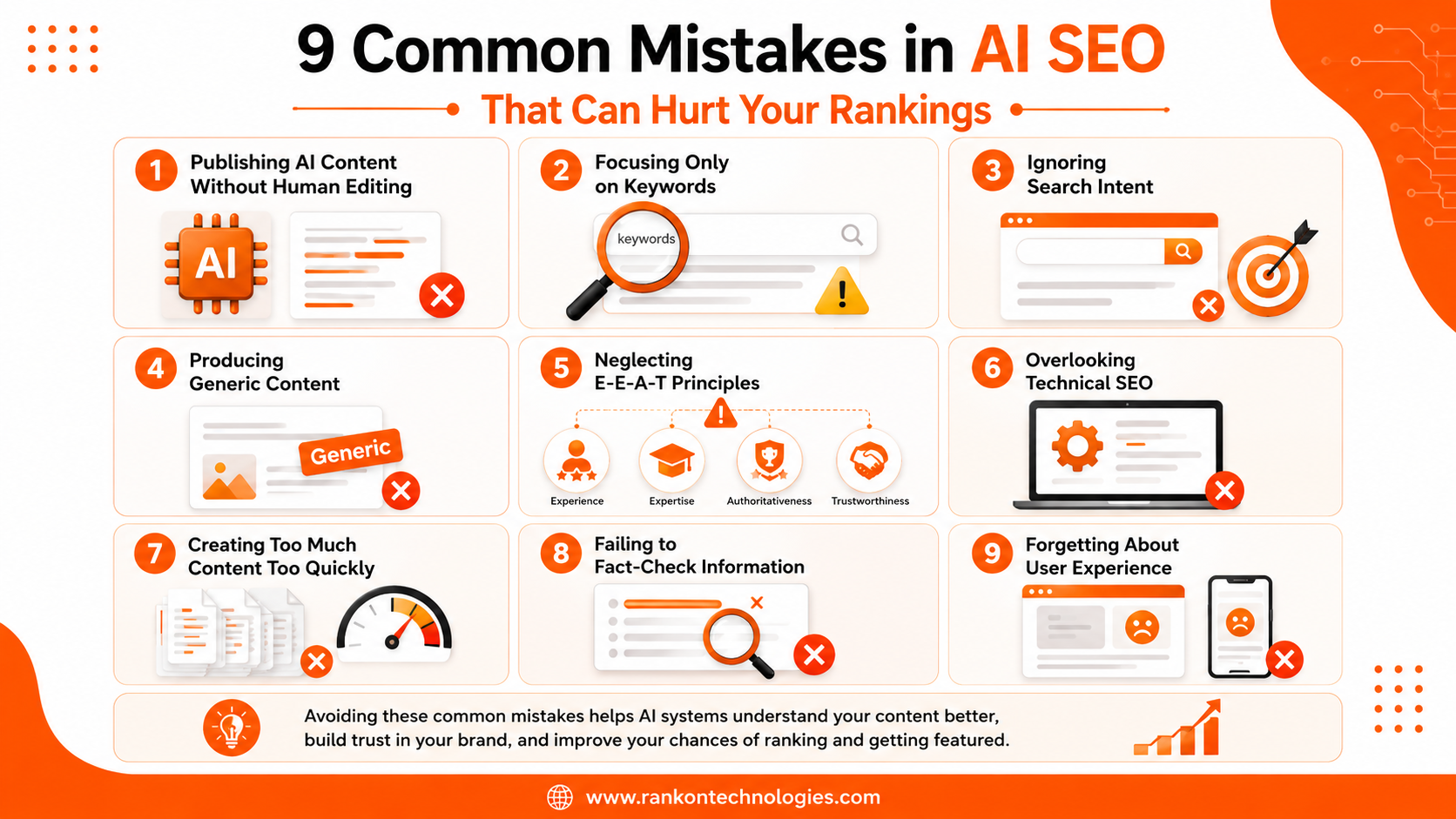
Here are the most common 9 SEO mistakes most businesses quickly make:
1. Publishing AI Content Without Human Editing
AI can produce content quickly, but it doesn’t always understand context, tone, or user intent. Publishing content exactly as generated can result in repetitive phrases, factual errors, and awkward sentences.
Human editing adds personality, accuracy, and value, making the content more useful for readers and more trustworthy in the eyes of search engines.
2. Focusing Only on Keywords
Many people use AI to insert keywords excessively throughout an article. This outdated practice, known as keyword stuffing, can make content difficult to read and may negatively affect rankings.
Instead, use keywords naturally and prioritize creating content that answers users’ questions.
3. Ignoring Search Intent
One of the biggest AI SEO mistakes is creating content without understanding why people are searching for a particular topic.
For example, someone searching for “best running shoes” wants recommendations, while someone searching for “how to clean running shoes” needs practical advice. AI-generated content should always align with the user’s intent.
4. Producing Generic Content
AI tools often generate information that resembles thousands of other articles online. Generic content rarely stands out or earns backlinks.
Adding real examples, industry insights, case studies, and expert opinions helps create original content that offers genuine value.
5. Neglecting E-E-A-T Principles
Google values Experience, Expertise, Authoritativeness, and Trustworthiness (E-E-A-T). Many AI-generated articles lack these elements because they don’t include firsthand knowledge or expert perspectives.
Businesses should enhance AI content with:
- Expert insights
- Credible sources
- Statistics and research
- Real-world examples
Writing AI proof content strengthens trust and improves overall content quality.
6. Overlooking Technical SEO
AI can assist with content creation, but it cannot replace technical SEO. Even the best-written article may struggle to rank if your website suffers from:
- Slow loading speeds
- Broken links
- Poor mobile usability
- Missing meta descriptions
- Incorrect heading structures
Technical optimization remains essential for long-term SEO success.
7. Creating Too Much Content Too Quickly
Publishing dozens of AI-generated articles every week doesn’t guarantee better rankings. Search engines prioritize quality over quantity.
A few well-researched, valuable articles often outperform hundreds of low-quality pages. Consistency matters, but quality should always come first.
8. Failing to Fact-Check Information
AI models occasionally generate inaccurate or outdated information. Blindly trusting the output can damage your credibility and lead to misinformation.
Before publishing, verify:
- Statistics
- Dates
- Industry trends
- Product information
- References and sources
Accuracy builds trust with both readers and search engines.
9. Forgetting About User Experience
SEO isn’t just about rankings; it’s about helping users. Some AI-generated content focuses so heavily on optimization that it becomes difficult to read.
Good user experience includes:
- Clear headings
- Short paragraphs
- Easy-to-understand language
- Relevant images
- Internal links
- Helpful answers
Content that satisfies readers is more likely to earn engagement and perform well in search results.
AI SEO Tool Stack for Better AI Visibility
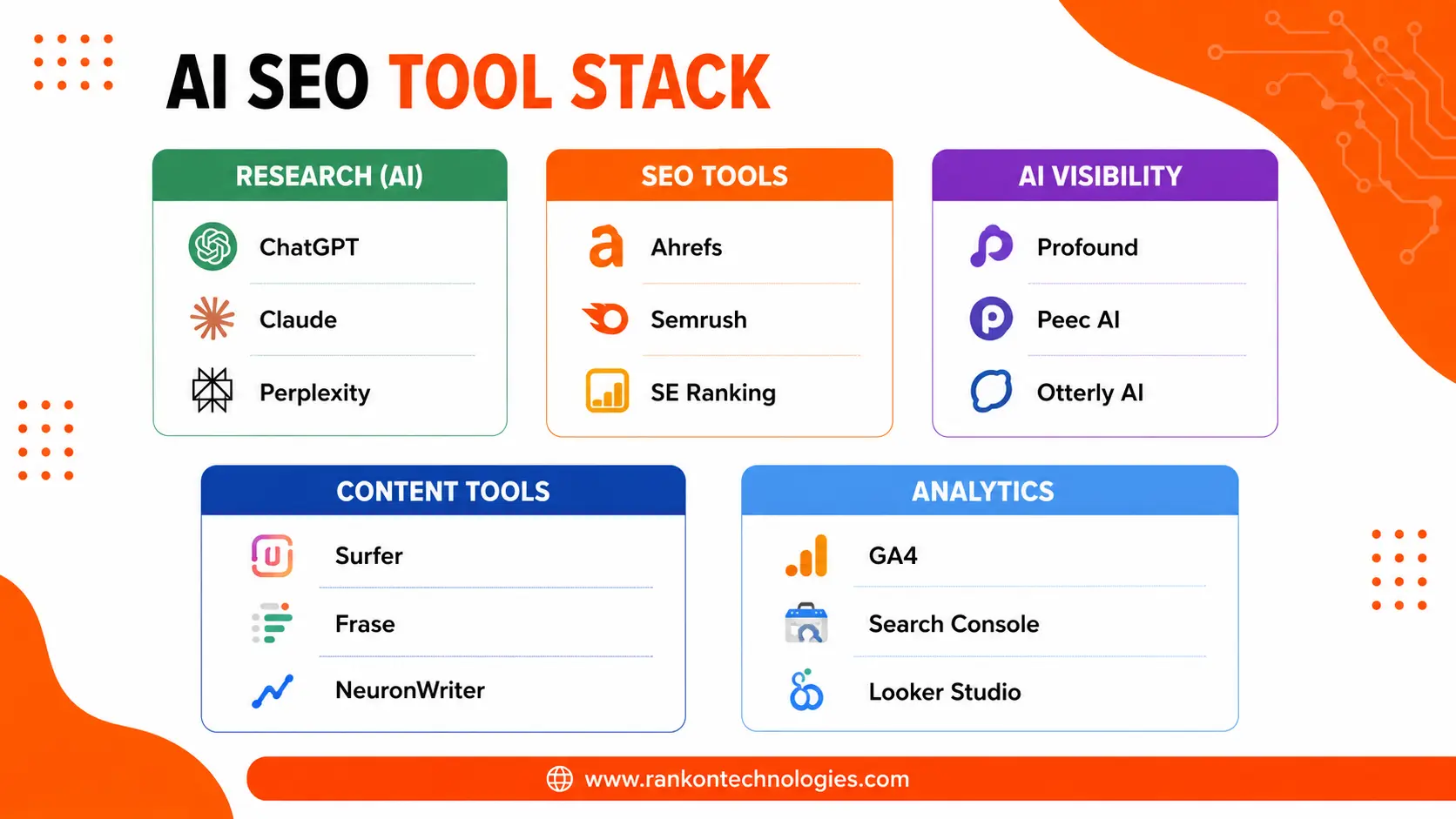
Building an effective AI SEO strategy requires the right combination of tools. Each tool serves a different purpose, from keyword research and content optimization to technical SEO and analytics.
Here’s a complete AI SEO tool stack for modern search.
1. Research Tools
Purpose: Discover keywords, topics, and search intent.
- ChatGpt
- Claude
- Perplexity
Key Benefits:
- Topic ideation
- Question and intent research
- Trend discovery
- Content clustering
- Competitor insights
2. SEO Tools
Purpose: Optimize websites and improve search rankings.
- Ahrefs
- Semrush
- SE ranking
Key Benefits:
- Keyword research
- Backlink analysis
- Site audits
- Rank tracking
- Competitor monitoring
3. AI Visibility Tools
Purpose: Monitor how brands appear in AI search engines and generative platforms.
- Profound
- Free AI
- AI
Key benefits:
- AI citation tracking
- Brand mention monitoring
- Generative engine optimization (GEO)
- Competitive benchmarking
- Visibility across ChatGPT, Gemini, and AI Overviews
4. Content Tools
Purpose: Create, optimize, and scale content.
- Surfer SEO
- Frase
- Neuron Writer
Key benefits:
- AI-assisted writing
- Content scoring
- Semantic optimization
- Topic coverage analysis
- Content brief generation
5. Analytics and Reporting Tools
Purpose: Measure traffic, rankings, conversions, and user behavior.
- Google Analytics 4 (GA4)
- Google Search Console
- Looker Studio
Key benefits:
- AI-assisted writing
- Content scoring
- Semantic optimization
- Topic coverage analysis
- Content brief generation
The Future of AI SEO
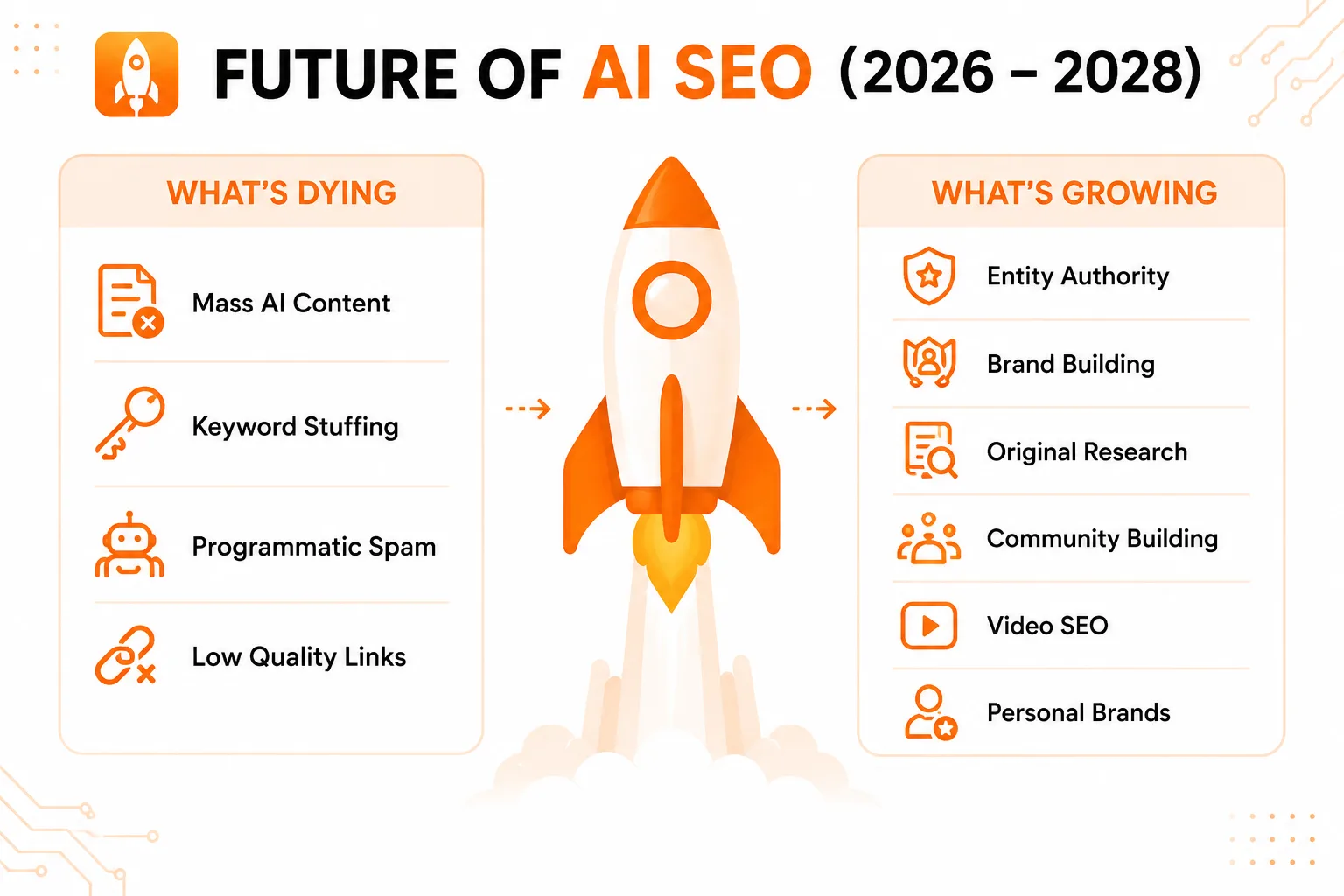
Artificial intelligence is expected to play a bigger role in search engine optimization, but human expertise will remain essential.
1. Smarter Search Experiences
AI will help search engines better understand user intent, leading to more personalized and relevant results.
2. Greater Focus on Content Quality
As AI-generated content becomes more common, search engines will reward websites that provide original insights, expertise, and trustworthy information.
3. Rise of Voice and Visual Search
Voice assistants and image-based searches will continue to influence how users find information online.
4. Human and AI Collaboration
The future of AI SEO lies in combining automation with creativity. Businesses that use AI strategically while prioritizing user experience and valuable content will be better positioned to achieve sustainable growth and long-term search visibility.
The future belongs to businesses willing to embrace change rather than resist it.
AI SEO Success Formula
Achieving success with AI SEO requires more than simply using AI tools. The most effective approach combines technology with human expertise and a strong focus on user needs.
AI SEO Success Formula:
High-Quality Content + User Intent + Technical SEO + E-E-A-T + AI Optimization + Continuous Analysis = Sustainable Rankings and Growth
Key Components:
- High-Quality Content: Create valuable, original, and informative content.
- User Intent: Understand what your audience is searching for and provide clear answers.
- Technical SEO: Ensure your website is fast, mobile-friendly, and easy to crawl.
- E-E-A-T: Demonstrate Experience, Expertise, Authoritativeness, and Trustworthiness.
- AI Optimization: Use AI tools for keyword research, content optimization, and data analysis.
- Continuous Analysis: Monitor performance, update content, and adapt to changing search trends.
AI can accelerate SEO efforts, but long-term success comes from combining AI-driven insights with human creativity, strategic thinking, and a commitment to delivering exceptional user experiences. And that’s where RankOn Technologies stands apart.
One of the most advanced strategies we implement is query fan-out optimization.
Is SEO Still Relevant in the Age of AI in 2026?
Yes, SEO is still highly relevant for generative AI search. AI search engines rely on content from their search indexes and use several AI techniques to identify, retrieve, and highlight the most relevant information.
Websites with high-quality, well-structured content are more likely to be surfaced in AI-generated responses.
Some of the key techniques include:
- Query Fan-Out: Expands a user’s question into multiple related searches to gather information from different sources.
- Semantic Search: Understands the meaning and context behind queries rather than matching exact keywords.
- Natural Language Processing (NLP): Interprets user intent and analyzes content in a human-like manner.
- Vector Embeddings: Maps content and queries into a semantic space to find closely related information.
- Retrieval-Augmented Generation (RAG): Retrieves relevant documents from the search index before generating an answer.
- Knowledge Graphs: Connect entities and concepts to provide richer, more accurate responses.
- Ranking Models: Evaluate relevance, authority, freshness, and content quality to prioritize trustworthy sources.
Why Clients Worldwide Trust RankON Technologies for SEO Services?
Choosing the right SEO partner is about more than improving keyword rankings. Businesses need an SEO agency that understands changing search behavior, builds sustainable strategies, and delivers measurable growth.
With 14+ years of SEO experience, 500+ completed SEO projects, and clients across multiple industries worldwide, RankON Technologies helps businesses improve their online visibility through data-driven SEO strategies.
As search continues to evolve, RankON has also adapted its approach toward AI SEO and AI-driven search optimization. Our team has helped multiple businesses improve their visibility in AI search experiences, including appearing in AI-generated recommendations and responses. We have also optimized our own website to gain visibility across AI search platforms, giving us practical experience in understanding how AI systems evaluate content, entities, authority, and trust signals.
Our AI SEO and SEO Expertise Includes:
- AI Search Optimization: Helping businesses improve their chances of appearing in AI-generated answers, recommendations, and citations.
- Traditional SEO Expertise: Complete SEO strategies covering technical SEO, content optimization, link building, local SEO, and enterprise SEO.
- Industry-Specific Experience: Proven SEO experience across healthcare, legal, financial services, real estate, SaaS, eCommerce, and other industries.
- Data-Driven Strategies: Using advanced SEO tools and analytics to identify opportunities, measure performance, and make informed decisions.
- Content and Authority Building: Creating expert-driven content, strengthening brand entities, earning quality mentions, and improving digital authority.
Why Businesses Choose RankON Technologies:
14+ Years of SEO Experience
Our team has been working in SEO for over a decade, adapting strategies through major search algorithm updates and the evolution from traditional search to AI-powered search.
500+ SEO Projects Completed
We have worked with businesses of different sizes and industries, helping them improve organic visibility, generate qualified traffic, and achieve long-term growth.
Top Rated Plus Agency on Upwork
RankON Technologies has earned recognition as a Top Rated Plus agency on Upwork, reflecting consistent client satisfaction and successful project delivery.
Award-Winning SEO Agency
Our SEO expertise has been recognized by platforms such as Clutch and 50Pros for delivering quality digital marketing solutions.
Experienced SEO Team
With a team of 20+ professionals, we bring expertise across technical SEO, content strategy, link building, analytics, and AI-focused search optimization.
Global Client Experience
We have helped businesses worldwide across different markets understand their audiences, improve search visibility, and build stronger online presence.
Transparent Reporting and Strategic Communication
Clients receive clear reporting, actionable insights, and regular updates to understand the progress and impact of SEO campaigns.
Continuous Learning and Innovation
Search is constantly changing. From Google algorithm updates to AI-powered search experiences, our team continuously adapts strategies to align with new opportunities.
At RankON Technologies, we combine proven SEO fundamentals with emerging AI search strategies to help businesses build visibility where their customers are searching today and where search is heading tomorrow.
Final Thoughts
AI SEO is reshaping the future of digital marketing, helping businesses achieve better rankings, increased visibility, and stronger results through smarter, data-driven strategies. However, lasting success requires the right blend of AI capabilities and human expertise.
That’s why businesses trust RankON Technologies. With customized SEO solutions, advanced AI-powered insights, and a proven track record of delivering measurable growth, RankOn Technologies helps brands stay ahead in an increasingly competitive online landscape.
Ready to Turn Traffic into Tangible Results With AI SEO? Partner with RankON Technologies Today!
RankON Technologies is a modern SEO company in India. Our SEO experts have 14+ years of experience working on different industries and we can definitely help you to rank your business in AI results.
Let our SEO experts help your business rank higher, attract more qualified leads, and achieve sustainable long-term growth. Contact us now and start your journey to the top of search results!
FAQs About AI SEO
What is AI SEO?
AI SEO is the process of using artificial intelligence technologies to improve content, technical SEO, keyword research, and overall search engine performance.
Can AI improve website rankings?
Yes, AI helps businesses understand user intent, optimize content, identify opportunities, and make data-driven decisions that improve rankings.
Is traditional SEO becoming obsolete?
No, traditional SEO principles remain important, but AI enhances and modernizes those practices.
Will AI replace SEO professionals?
Not at all, AI supports SEO professionals by automating repetitive tasks, but human creativity, expertise, and strategic thinking remain irreplaceable.
Want to Learn More About Our AI SEO Strategies? Contact RankOn Technologies Today!
Frequently Asked Questions About AI SEO Strategy
What is an AI SEO strategy?
An AI SEO strategy is the process of optimizing a website, content, and brand presence to improve visibility in AI-powered search experiences such as ChatGPT, Google AI Overviews, Gemini, and Perplexity.
Unlike traditional SEO, which focuses mainly on improving rankings in search engine results pages, AI SEO focuses on helping AI systems understand, trust, and recommend a business as a reliable source of information.
An effective AI SEO strategy includes:
- AI-focused keyword research
- Conversational query optimization
- Content optimization
- Entity SEO
- Technical SEO
- Brand authority building
- Digital mentions and reputation management
How is AI SEO different from traditional SEO?
Traditional SEO focuses on ranking web pages for specific keywords in search results, while AI SEO focuses on increasing visibility in AI-generated answers and recommendations.
Key differences include:
Traditional SEO focuses on:
- Keyword rankings
- Organic traffic
- Backlinks
- On-page optimization
AI SEO focuses on:
- AI citations and mentions
- Brand entity recognition
- Content depth and expertise
- Conversational queries
- Digital authority signals
AI SEO does not replace traditional SEO; it expands SEO strategies for the changing search landscape.
Why is AI SEO important for businesses in 2026?
AI search is changing how users discover information and make purchasing decisions. Many users now ask AI assistants for recommendations, comparisons, and solutions instead of manually browsing multiple websites.
AI SEO helps businesses:
- Increase visibility in AI-generated responses
- Reach customers earlier in the buying journey
- Build stronger brand authority
- Improve chances of being cited by AI platforms
- Stay competitive as search behavior evolves
How do AI search engines choose which websites to recommend?
AI search engines evaluate multiple signals before recommending a source, including:
- Content relevance and quality
- Topical expertise
- Brand authority
- Website structure
- Entity information
- Reviews and reputation
- Online mentions
- User intent match
Businesses that provide accurate, comprehensive, and trustworthy information have a better chance of appearing in AI-generated answers.
What are the key steps in creating an AI SEO strategy?
A complete AI SEO strategy includes:
- AI-focused keyword and query research
- Competitor analysis
- Topic cluster development
- Content optimization
- Technical SEO improvements
- Entity SEO implementation
- Brand mention building
- Digital reputation management
- AI visibility tracking
Each step helps AI systems better understand your expertise and relevance.
Does traditional SEO help with AI SEO?
Yes. Traditional SEO provides the foundation for AI SEO.
Technical SEO, quality content, backlinks, internal linking, and website authority all contribute to AI visibility.
However, AI SEO adds additional focus areas such as:
- Conversational search optimization
- Entity relationships
- Query fan-out content
- Brand mentions
- AI citation opportunities
A strong SEO foundation makes it easier for AI systems to discover and understand your website.
How do I optimize my website content for AI search?
To optimize content for AI search:
- Answer the main user query clearly
- Cover related questions and topics
- Use structured headings
- Include FAQs
- Add real examples
- Share expert insights
- Include first-hand experiences
- Keep information updated
- Build topical depth through related content
AI systems prefer content that provides complete answers rather than content created only around keywords.
What is query fan-out in AI SEO?
Query fan-out is the process AI systems use to expand a user’s search query into multiple related questions and topics.
For example:
Main query:
“Best SEO company”
Related queries may include:
- How to choose an SEO agency?
- How much does SEO cost?
- SEO company vs freelancer
- Best SEO agency for small businesses
- SEO results timeline
Creating content that covers these related questions helps businesses improve their chances of appearing in AI-generated answers.
What role does Entity SEO play in AI search?
Entity SEO helps AI systems understand who you are, what you do, and how your brand connects with related topics.
Entities can include:
- Companies
- People
- Services
- Products
- Locations
- Industries
A strong entity SEO strategy includes:
- Consistent business information
- Optimized About pages
- Expert profiles
- Organization schema
- Brand mentions
- Industry associations
This helps AI systems build a clearer understanding of your business.
How important are backlinks and brand mentions for AI SEO?
Backlinks and brand mentions remain important because they help establish authority and trust.
AI systems may consider:
- Mentions from industry websites
- Expert references
- News coverage
- Business directories
- Reviews
- Partnerships
A brand that is consistently recognized across trusted sources is more likely to be considered authoritative.
Can small businesses benefit from an AI SEO strategy?
Yes. AI SEO can benefit small businesses by helping them compete through expertise, relevance, and niche authority.
Small businesses can improve AI visibility by:
- Creating industry-specific content
- Answering customer questions
- Building strong reviews
- Publishing expert resources
- Optimizing local business information
A focused AI SEO strategy can help smaller businesses become recognized sources within their niche.
How long does it take to see results from AI SEO?
The timeline depends on factors such as:
- Website authority
- Competition level
- Content quality
- Technical SEO condition
- Brand reputation
Some improvements, such as better content structure and technical fixes, can show impact sooner. Building strong entity authority and AI visibility usually requires consistent long-term effort.
How can I measure AI SEO success?
AI SEO success can be measured through:
AI Mentions
- Brand appearances in AI-generated responses
AI Citations
- Website pages referenced by AI platforms
Organic Visibility
- Rankings
- Traffic
- Search impressions
Brand Growth
- Increase in branded searches
- Online mentions
Business Results
- Qualified leads
- Conversions
- Revenue impact
Should businesses hire an AI SEO agency?
Businesses should consider working with an AI SEO agency when they want to adapt their SEO strategy for AI-powered search.
An experienced AI SEO agency can help with:
- AI search analysis
- Content optimization
- Entity SEO
- Technical improvements
- Competitor research
- Brand authority building
- AI visibility tracking
The right partner combines traditional SEO expertise with an understanding of how AI search systems evaluate and recommend information.
Can RankON Technologies help businesses with AI SEO?
Yes. RankON Technologies combines 14+ years of SEO experience with emerging AI SEO strategies to help businesses improve visibility across traditional and AI-powered search platforms.
Our team has helped businesses improve their presence in AI search experiences and has optimized RankON’s own website to gain visibility in AI-driven search results.
Our AI SEO approach includes:
- AI-focused keyword research
- Content strategy and optimization
- Technical SEO improvements
- Entity SEO
- Brand authority building
- Digital mentions
- AI visibility analysis
With 500+ completed SEO projects, global client experience, a 20+ member SEO team, and recognition from platforms like Upwork, Clutch, and 50Pros, RankON Technologies helps businesses prepare for the future of search.